
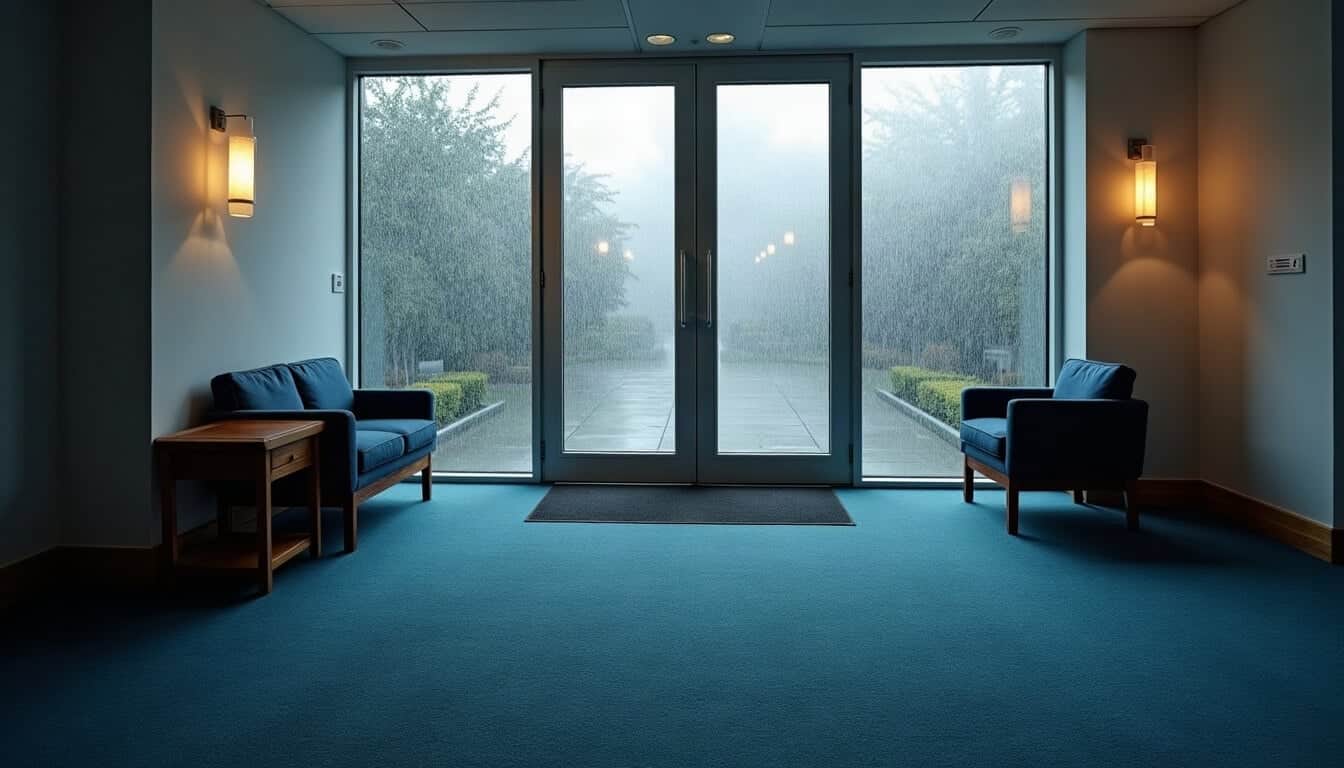
The first wet week of the season rarely makes the incident log. Nobody calls a crisis team because the entrance carpet has gone dark and tacky, the lobby smells of damp wool by mid-morning, and someone in accounts nearly slipped on the tile where the runner ends. Yet that is how a floor starts to cost you time: a slip report, a client meeting moved to another room, a section of the office that people quietly stop using.
The time to sort this out is not the morning an office manager types carpet cleaning Lacey WA into a search box with a soaked runner drying over a chair. In this insight we treat floor care in a rainy climate like the South Sound as what it really is in a continuity plan: a control with an owner, a schedule and a test, rather than a line in the facilities budget that only gets attention when something smells wrong.
The entrance zone in a wet winter
Exposure. In a damp, grey Pacific Northwest winter, the first few meters inside the door take the full load. Grit, road film and water arrive on every pair of shoes, and the carpet near the entrance holds that moisture far longer than anyone expects. It usually starts as discoloration in a traffic lane, then a smell, then fibers that stop springing back.
Impact. The obvious cost is a slip or trip at the transition between wet carpet and hard floor, which is a health and safety matter before it is anything else. The quieter cost is image and use: a reception area that looks neglected in front of visitors, and an entrance that staff avoid by using a side door you never meant to be the main route.
Control. We would set a cleaning frequency for the entrance zone that rises with the season rather than staying flat all year. That means more frequent vacuuming and spot work in the wet months, a scheduled deep clean before the rain sets in and another as it eases, and walk-off matting that is cleaned or swapped on a rota. A professional commercial cleaner can advise on frequency for your traffic levels and floor types; the decision on how often belongs to whoever owns the facility budget.
Test. Once a month in the wet season, stand at the door at the busiest hour and watch. Where do people stop wiping their feet? Where does the wet trail end? If it ends well inside the carpeted area, the matting or the schedule is not doing its job.
After the leak is fixed
Exposure. A failed supply line in the kitchenette, a roof that let water in over a long weekend, a sprinkler head knocked by a ladder. The plumber or roofer stops the water, and the plan often stops there too. The carpet is left to "dry out" on its own.
Impact. This is where an event that was handled turns into one that lingers. Carpet and the pad beneath it can hold water out of sight, and a floor that looks dry on Monday can smell by Thursday. The area may need to be closed off while the cause is assessed, and if the space is a meeting room or an open-plan bank of desks, that is real work-area capacity gone. Work-area recovery, in plain terms, means having somewhere usable for people to sit when their normal space is out of action, and a damp floor quietly eats into it.
Control. Separate the steps and name who owns each one. The source of the water is a job for the relevant trade. Significant water, standing water or any sign of mold growth is a job for a water damage or mold remediation specialist, and in a leased building your landlord or property manager will usually need to be told first. Cleaning comes after the space has been properly dried and assessed, and it is the step that returns the room to normal use. Write that sequence into your plan so nobody skips from "the leak is fixed" straight to "the room is open".
Single point of failure: in most offices we walk through, the only person who knows which cleaning provider to call, and how to reach them outside office hours, is the office manager. Put the provider's out-of-hours contact on the call tree next to the plumber and the landlord, with a named backup who can authorize the work.
Test. Run a short tabletop exercise, a walk-through of a scenario around a table rather than in the building: "Water came through the ceiling over the meeting room on Saturday. It is Monday at 7 a.m." Ask who is called first, who decides the room is safe to use, and who books the cleaning. If the answers take more than a few minutes, the sequence is not written down.
Readiness kit
- APC Back-UPS Pro BR1000MS1000 VA / 600 W, sine waveGo to Abt
- EcoFlow DELTA 3 Plus1,024 Wh, under 10 ms UPSGo to EcoFlow
- BLUETTI AC200L2,048 Wh, UPS modeGo to BLUETTI
Reopening after a closure
Exposure. Offices close for longer than people plan: a holiday shutdown, a renovation, an extended power or heating problem, a period when staff worked from home. Dust settles, construction debris travels, and an HVAC system that sat idle can push stale air through the space when it restarts.
Impact. The first day back is when a business is most exposed to a bad impression. Staff walk into a space that looks and smells closed. Visitors notice. If a renovation is involved, fine dust in carpets and on surfaces is not something people should be working in, and the reopening date slips while someone arranges a clean at short notice.
Control. Treat a reopening clean as a planned step with a date, not an afterthought. When you schedule a renovation or a planned closure, book the cleaning for the day before people return, and include carpets, hard floors and high-touch surfaces. A commercial cleaning company can tell you how much notice it needs for a job of that size, which is the number you actually want in your plan.
Test. For your next planned closure, check the reopening checklist before the closure starts, not after. If cleaning is not on it with a booked date, add it.
The contract nobody has read
Exposure. Many cleaning arrangements were set up years ago by someone who has since moved on. The scope is a short paragraph, the schedule is whatever has become habit, and nobody can say whether deep cleaning of carpets is included or extra.
Impact. When you need more than the routine visit, after a leak, before an inspection or ahead of an important client day, you find out at the worst moment what the arrangement does and does not cover. Decisions get made by phone under time pressure, and the invoice becomes a surprise.
Control. Read the current scope with the provider and write down three things: what is routine and how often, what is on request and how quickly it can be arranged, and who on each side can approve additional work. Keep a simple service record of when deep cleans actually happened. It helps with budgeting, and it is the kind of maintenance evidence a landlord, a broker or an insurer may ask to see after an event. For anything about lease obligations or cover, speak with your own property manager, broker or attorney.
Test. Ask a colleague who is not the usual contact to find the scope, the out-of-hours number and the date of the last deep clean. If they cannot do it in ten minutes, the control exists only in one person's head.
Putting it on a calendar
The point of all this is that floor care becomes predictable work rather than reactive work. A simple rhythm covers most small and mid-size offices:
| When | What | Owner |
|---|---|---|
| Do now | Confirm the cleaning provider's routine and on-request scope; add the out-of-hours contact and a backup approver to the call tree | Office or facilities manager |
| Before the wet season | Deep clean of entrance zones and main traffic lanes; check walk-off matting and its rota | Facilities manager with the provider |
| After any water event | Source fixed, space dried and assessed by the right specialist, then cleaning, then reopen | Incident owner named in the plan |
| Annual | Review the scope, frequency and service record against how the space is really used | Budget owner |
It needs a name against each row and a date in a shared calendar, not someone's memory of last year.
What to do this quarter
- Find the scope of your current cleaning arrangement and write down what is routine, what is on request, and who can approve extra work.
- Add the provider to the call tree with an out-of-hours contact and a named backup, next to your plumber and landlord.
- Book the pre-season deep clean of entrance zones now, while the calendar is still open.
A carpet will never be the headline of an incident report, which is exactly why it should not be left to chance.
Readiness kit
| Category | Pick | Why it is on the list | Link |
|---|---|---|---|
| UPS, sine wave | APC Back-UPS Pro BR1000MS | Sine wave output, 10 outlets and an LCD: a desk UPS for the minutes a desktop needs to save and shut down. | Go to Abt |
| Power station, UPS mode | EcoFlow DELTA 3 Plus | A 1 kWh class station with a UPS mode EcoFlow rates at under 10 ms: the network and a laptop through a full outage day. | Go to EcoFlow |
| Power station, 2 kWh class | BLUETTI AC200L | 2,048 Wh with a UPS mode, the size an 8-hour desktop workday at about 200 W calls for. | Go to BLUETTI |
Matched to this topic from manufacturer specifications and published reviews; not tested by us. See the Readiness kit