
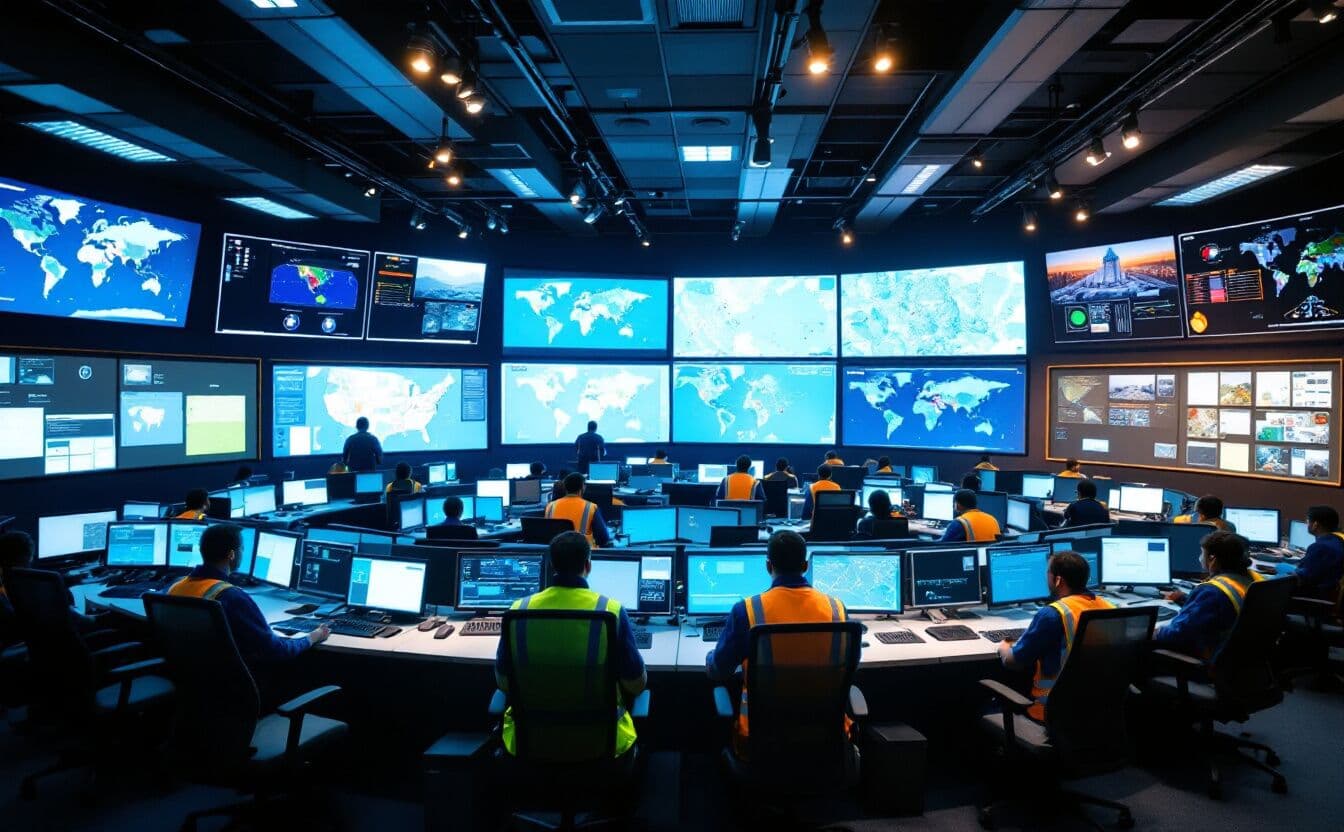
On an ordinary weekday, most municipal emergency operations centers are quiet. A watch desk is staffed, screens cycle through weather radar and traffic cameras, and rows of workstations sit empty under signs naming agencies and functions. Come back during a full activation and every seat is filled, yet the room is still not loud. That calm is engineered. It comes from fixed roles, a fixed meeting rhythm and a shared picture of the situation that everyone in the room is working from.
Continuity professionals who walk through a public EOC tend to leave with the same reaction: our crisis team has the right people, but none of the machinery. This briefing explains how that machinery works and which parts translate to a company.
Start with what an EOC is not
An EOC is not where the incident is run. Tactical control sits at the incident command post (ICP), on or near the scene, where an incident commander directs responders under the Incident Command System (ICS). The fire chief decides how to fight the fire; the police commander decides where the perimeter goes.
The EOC sits away from the scene and does four things the ICP cannot:
- Coordinates across incidents. During a hurricane or a citywide blackout there may be dozens of command posts and one EOC setting priorities among them.
- Finds and allocates resources. Generators, buses, shelters, mutual aid from neighboring jurisdictions, state and federal assistance.
- Makes policy decisions. Evacuation orders, curfews, emergency declarations, which neighborhoods get power restored first.
- Manages information. Collecting, verifying and distributing a single picture of the situation, and coordinating public messaging.
This split is the first lesson for business. Corporate crisis teams often try to run site tactics from headquarters, second-guessing the facility manager who can actually see the water coming in. The better model is the public one: the site team handles the scene, the corporate team supports it, sets priorities and makes the decisions only it can make.
Activation levels
EOCs scale up and down rather than switching on and off. The national doctrine in the National Incident Management System (NIMS) describes three common levels, though jurisdictions number and name them differently.
| Level | What it looks like | Typical trigger |
|---|---|---|
| 3: Normal operations / steady state | Watch desk monitoring weather, alerts and news; routine coordination | Daily operations |
| 2: Enhanced steady state / partial activation | Selected functions staffed, often including the situation unit and key agencies | A forecast storm, a large planned event, a developing incident |
| 1: Full activation | All functions staffed, often around the clock, with leadership present | A major incident affecting large parts of the jurisdiction |
Two habits are worth copying. First, triggers are written down in advance, so activation is not a debate held under pressure. Second, partial activation is used freely. Staffing a few seats for a forecast that turns out to be a near miss costs a few hours of staff time; activating late costs much more. Most corporate plans have only "normal" and "crisis," which pushes teams to wait until they are certain, and by then they are behind.
How EOCs are organized
There is no single mandated structure. NIMS recognizes several, and many jurisdictions run hybrids.
ICS-based structure
The EOC mirrors ICS, with management on top and sections for operations, planning, logistics, and finance and administration. Responders already know the vocabulary, which shortens training. The risk is that an EOC "operations section" starts competing with the incident commanders it exists to support. NIMS describes a variant, the Incident Support Model, that replaces operations with situational awareness and resource support to make the support role explicit.
Emergency Support Function structure
Seats are organized by function rather than by agency, following the pattern of the National Response Framework's federal Emergency Support Functions (ESFs): transportation, communications, public works, firefighting, mass care, public health and medical, energy, public safety and so on. Each function has a lead agency and supporting agencies. Since the framework's fourth edition in 2019, ESF #14 has been Cross-Sector Business and Infrastructure, which formalizes a place for private-sector coordination. Some states add functions beyond the federal set, including ones dedicated to business and industry.
Departmental structure
Each department sends a representative who works the problem from their agency's perspective, with an EOC manager coordinating. It is simple and works for smaller jurisdictions and short events. It is weakest on problems that belong to no single department, which in a large disaster is most of them.
For a company, the ESF idea transfers best. Organize the crisis team around what needs doing (people, facilities, technology, customers, suppliers, communications, finance) rather than around the org chart, and assign each function a lead and a deputy.
The situational awareness cycle
The machinery that keeps an EOC calm is a repeating cycle built around the operational period, a fixed block of time (12 or 24 hours is common) with its own objectives.
Within each period, the rhythm looks roughly like this:
- Shift briefing. Incoming staff hear the current situation, objectives and open issues.
- Information collection. The situation unit gathers reports from field units, utilities, hospitals, the National Weather Service, other jurisdictions and media monitoring. Every item carries a source and a time. Unconfirmed reports are labeled as such.
- Situation report (SitRep). Published at set times, in a fixed format, whether or not much has changed. A SitRep that arrives on schedule saying "no significant change" is more useful than one that arrives whenever someone has time.
- Common operating picture (COP). Maps, status boards and dashboards that everyone in the room and every partner outside it is working from. When two people disagree about how many shelters are open, the COP settles it.
- Planning meeting. Objectives and priorities for the next operational period, captured in an EOC action plan.
- Leadership briefing. Decisions needed, framed with options.
Resource requests run alongside this cycle with their own tracking: who asked for what, when, who is filling it and the expected arrival. Unfilled requests are reviewed at every briefing.
A corporate SitRep needs only six headings: what happened; current status; impact on people, facilities, operations and customers; actions under way; decisions needed; and the time of the next update. If your team produces that on a schedule, you have most of the value of an EOC already.
Where the private sector fits
Public EOCs depend on information only businesses have. Which grocery stores and pharmacies are open, where fuel is available, when cell service will return, what the power restoration estimate looks like by neighborhood. That is why utilities and telecommunications carriers are fixtures in most activated EOCs.
Private-sector connections take several forms:
- Liaison seats. Larger jurisdictions often give utilities, hospitals, carriers and sometimes business associations a physical or virtual seat during activations.
- Business emergency operations centers (BEOCs). Some states and regions operate a dedicated center or virtual network to share information with businesses: road closures, curfews, re-entry procedures, and requests for donated goods.
- The federal level. FEMA's National Business Emergency Operations Center coordinates information sharing between government and business, industry and infrastructure organizations before, during and after disasters. Businesses and industry groups can take part by completing an agreement with FEMA.
The practical steps are unglamorous: learn who runs emergency management where you have significant sites, ask whether they have a private-sector program, find out how re-entry credentials work for critical staff after an evacuation, and make sure they have a current after-hours contact for you. Our briefing on public–private partnerships in emergency management covers how those relationships are built and sustained.
City EOC and corporate crisis center compared
| City EOC | Corporate crisis center | |
|---|---|---|
| Purpose | Protect life, property and the community; coordinate public response | Protect people, operations, customers and reputation |
| Authority | Statute, emergency declarations, mayoral or executive orders | Board-approved policy and delegated authority |
| Tactical control | Stays with incident commanders at the scene | Should stay with site and functional teams |
| Organizing model | ICS-based, ESF-based, departmental or hybrid | Usually functional; ESF-style works well |
| Activation | Written levels and triggers, frequent partial activation | Often binary; partial activation underused |
| Rhythm | Operational periods, scheduled SitReps and briefings | Frequently ad hoc meetings |
| Information | Field reports, utilities, weather service, partners | Site teams, IT monitoring, vendors, HR, media |
| Public information | Joint information center, official alerts | Corporate communications, employee notification |
| Cost tracking | Detailed records for state and federal reimbursement | Records for insurance claims and audit |
| Common failure | Information overload, unverified reports | Senior leaders doing tactics, no decision log |
Designing your own crisis room
Ten decisions, roughly in order:
- Define the room's job. Strategic coordination and decisions, not tactics.
- Choose physical, virtual or both. Since 2020, many corporate teams default to a video bridge. Keep a physical fallback with backup power and connectivity that does not depend on headquarters systems.
- Assign roles before buying furniture. Crisis lead, deputy, log keeper, situation lead, functional leads, and a liaison for outside agencies.
- Build one common operating picture. A single shared status board, not a dozen chat threads. People's accountability status should be a standing line on it; see our briefing on duty of care in a crisis.
- Fix the rhythm. Meetings at set times, a SitRep before each one, a hard stop.
- Plan for losing your collaboration tools. Ransomware or a failure like the CrowdStrike Falcon outage of 19 July 2024 can take out the platform you planned to meet on. Keep an out-of-band bridge and contact list.
- Keep a decision log. Time, decision, who made it, what was known.
- Write activation levels and triggers. Include a partial level.
- Staff for duration. People cannot run 16-hour days for a week. Name second shifts.
- Exercise it. A tabletop that runs the full SitRep cycle exposes more than one that only tests the first hour; our guide to tabletop exercises that expose real gaps explains how to build one.
Frequently asked questions
What is the difference between an EOC and an incident command post?
The incident command post is at or near the scene and directs tactical response under the Incident Command System. The EOC operates away from the scene and supports it: coordinating across incidents, finding resources, making policy decisions and managing information. One EOC may support many command posts at once.
Does a business need its own emergency operations center?
Most need the function, not the facility. A crisis team with defined roles, activation levels, a SitRep cycle and a shared status board covers the essentials, whether it meets in a conference room or on a video bridge. Large organizations with many sites or round-the-clock operations sometimes justify a dedicated room with backup power.
How can a company connect with its local EOC?
Start with the city or county emergency management agency and ask whether it runs a private-sector program or a business emergency operations center. Utilities, hospitals and critical infrastructure operators are often given liaison seats; other businesses usually connect through information-sharing networks. At the federal level, FEMA's National Business Emergency Operations Center accepts business and industry participants.
What tools do EOCs use?
Most use an incident management platform for logs, resource requests and SitReps, plus mapping software and shared dashboards. Corporate teams can start with their existing collaboration suite and a disciplined template. The format and the rhythm matter more than the software, and any tool needs a fallback if it goes down.