OSHA does not require a particular first aid kit. Its general industry rule, 29 CFR 1910.151, says adequate first aid supplies must be readily available, and that someone must be trained to give first aid when no clinic or hospital is in near proximity. The contents are left to the employer. A non-mandatory appendix to the rule points to the ANSI Z308.1 standard as an example of minimum contents, and its current edition, ANSI/ISEA Z308.1-2021, is what most workplace kits are now built and labeled against.
Ready list

Be Smart Get Prepared 326-piece first aid kit 326 pieces
A wall-mountable 326-piece hard case for a workplace first aid station; check the ANSI edition and class on the label.
$39.99 Checked on Amazon Oct 21, 2026, 4:25 PM UTC Product prices and availability are accurate as of the date/time indicated and are subject to change.

SmartCompliance 50-person first aid cabinet up to 50 people
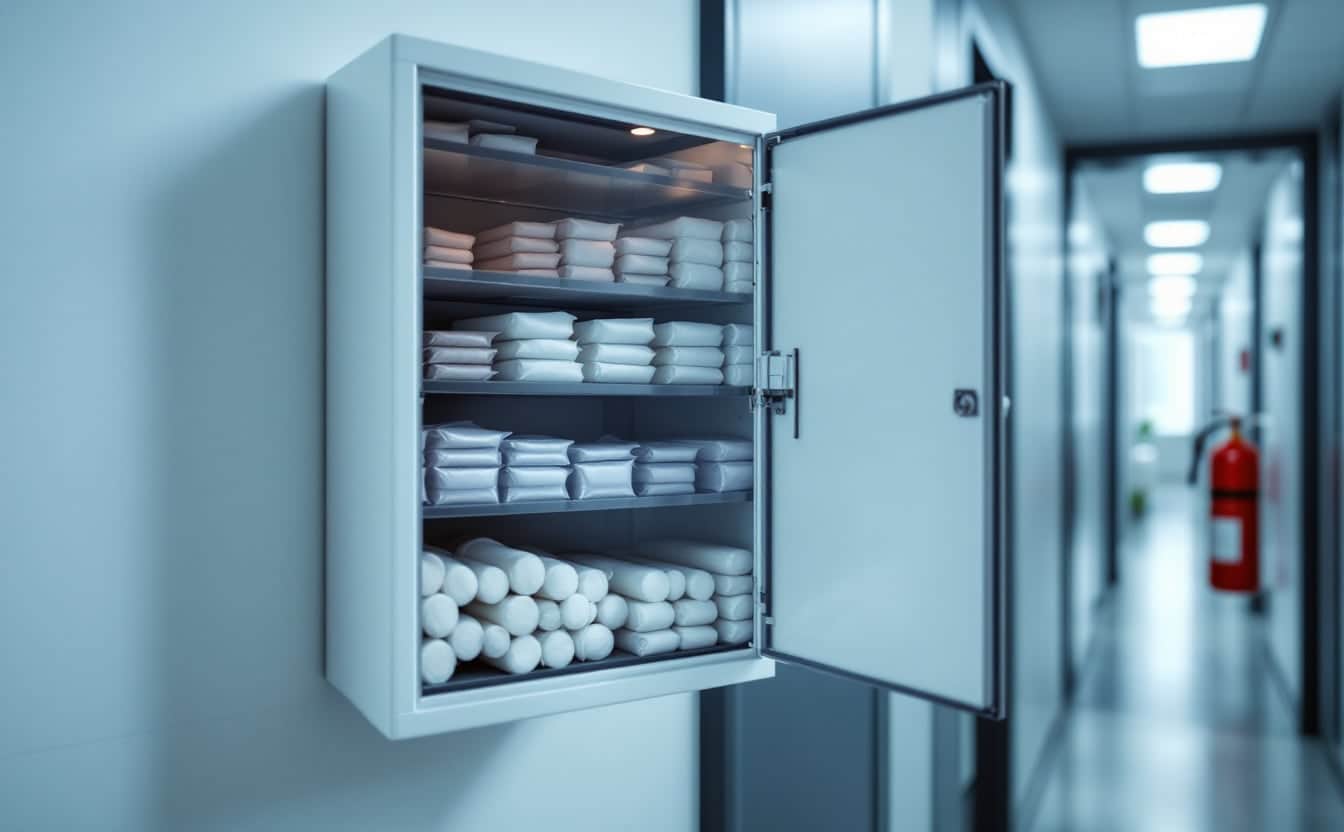
Refillable cabinet with medications, sized for up to 50 people; confirm the ANSI edition and class on the box.
$98.17 Checked on Amazon Oct 21, 2026, 4:25 PM UTC Product prices and availability are accurate as of the date/time indicated and are subject to change.
Chosen from manufacturer specifications and published reviews, not tested by us. The full Readiness kit
So the working answer to "what makes a first aid kit OSHA compliant" is this: a kit that meets the current ANSI/ISEA contents for the right class, placed where people can reach it within minutes, topped up for the hazards you actually have, and restocked by someone whose job it is. The sections below take those in order, then name two picks.
What OSHA 1910.151 actually says
The general industry standard has three short paragraphs:
- Medical personnel must be readily available for advice and consultation on workplace health.
- Where no infirmary, clinic or hospital used to treat injured employees is in near proximity, one or more people must be adequately trained to render first aid, and adequate first aid supplies must be readily available.
- Where the eyes or body may be exposed to injurious corrosive materials, facilities for quick drenching or flushing must be provided within the work area for immediate emergency use.
OSHA measures "near proximity" in minutes, not miles. In its interpretation letters the agency has read it as 3 to 4 minutes where serious injuries such as falls, suffocation, electrocution or amputation are possible, and up to 15 minutes in workplaces such as offices where those injuries are less likely. A downtown office near a fire station may meet that with emergency services alone; a warehouse at the edge of town usually needs trained staff on every shift.
The appendix fills in the rest. It names the 1998 edition of ANSI Z308.1 as an example of minimal contents, says those contents should be adequate for small worksites, and tells employers with larger or multiple operations to add kits, equipment and quantities. It suggests reading the OSHA 300 and 301 injury logs to spot unusual needs, and asking the local fire and rescue service, a medical professional or an emergency room for advice. Where first aid could expose someone to blood, the bloodborne pathogens standard requires suitable protective equipment such as gloves and eye protection.
Construction has its own rule, 1926.50. Supplies must be easily accessible, kept in a weatherproof container with individually sealed packages, and checked before the kit goes out to each job and at least weekly on every job. State plans can go further. California's Title 8, section 3400, requires first aid materials approved by the consulting physician, kept sanitary and usable, and inspected frequently.
There is no "OSHA approved" first aid kit
OSHA does not approve, certify or list kits. In a 1976 interpretation letter it said it had never specified the contents of a kit, and that any suggestion it approves the supplies in a kit or cabinet was false. "OSHA compliant" on a box is the maker's claim. What you can check is the ANSI/ISEA edition and the class printed on the label.
ANSI/ISEA Z308.1-2021: Class A, Class B and the four types
The 2021 edition sorts kits two ways: by class, which sets the contents, and by type, which sets the container.
Class A kits cover the most common workplace injuries, such as minor cuts, abrasions and sprains. Class B kits carry a broader range and larger quantities for more complex or higher-risk environments, and they add two items Class A does not have: a splint and a tourniquet. Here are selected minimums from the 2021 contents table, as published by the environmental health and safety office of the College of Southern Nevada; the kit maker First Aid Only describes the classes and types the same way in its own summary.
| Item (minimum) | Class A | Class B |
|---|---|---|
| Adhesive bandages, 1 x 3 in | 16 | 50 |
| Antiseptic applications | 10 | 50 |
| Antibiotic applications | 10 | 25 |
| Burn treatment applications | 10 | 25 |
| Trauma pads, 5 x 9 in | 2 | 4 |
| Exam gloves, pairs | 2 | 4 |
| Cold packs | 1 | 2 |
| Eye and skin wash | 1 fl oz | 4 fl oz |
| Roller bandages | one 2 in | two 2 in, one 4 in |
| Foil blanket | 1 | 1 |
| Splint | none | 1 |
| Tourniquet | none | 1 |
Both classes also include a CPR breathing barrier, a burn dressing, eye coverings, a first aid guide, hand sanitizer, scissors, tape, sterile pads and a triangular bandage.
The type describes the container. Type I is for stationary indoor use, mounted in one place; most first aid cabinets fall here. Type II is portable indoor, with a carrying handle. Type III is portable for mobile or sheltered outdoor use, mountable, with a water-resistant seal. Type IV is built for rough handling outdoors and in mobile industries such as transportation, utilities and construction, and has to meet the standard's corrosion, moisture and impact tests.
| Kit class and type | Typical workplace | What it adds |
|---|---|---|
| Class A, Type I | Office floor, reception, break room | A fixed spot everyone learns; basic wound, burn and eye care |
| Class A, Type II | Responder's bag, off-site events | Same contents with a handle, carried to the injured person |
| Class B, Type I or II | Commercial kitchen, mailroom, light assembly, busy public space | Larger quantities, splint, tourniquet, wider bandage |
| Class B, Type III | Warehouse, loading dock, sheltered yard | Water-resistant seal; mounts on a wall or travels |
| Class B, Type IV | Vehicles, field crews, construction | Resists impact, moisture and corrosion |
Readiness kit
- Be Smart Get Prepared 326-piece first aid kit326 piecesShop on Amazon
- SmartCompliance 50-person first aid cabinetup to 50 peopleShop on Amazon
As an Amazon Associate I earn from qualifying purchases. All picks
How to size kits by time, headcount and hazard
Start with time. A kit helps only if it reaches the injured person in the first few minutes, so plan at least one per floor and one beside each higher-risk area: the kitchen, the shop, the loading dock. Keep kits outside locked rooms so every shift can reach them.
Then headcount. Kit labels carry a person count, typically 10, 25 or 50. Treat it as the maker's guide to how quickly the supplies run down, not a legal threshold. When a floor outgrows the label, add a second kit or move up to a refillable cabinet sized for up to 50 people, and remember that the OSHA appendix expects larger operations to add kits rather than stretch one.
Then hazard. Read the injury logs and near-miss reports for patterns: burns in the kitchen call for more burn dressings, box cutters in the mailroom for more trauma pads and a Class B kit, outdoor work in summer for cooling supplies and a heat plan (our extreme heat playbook covers the triggers). Field crews and vehicles need Type III or IV containers.
A worked example: 120 people on three office floors, plus a ground-floor mailroom and loading dock. That works out to one Class A, Type I cabinet per floor near the stair core (three), one Class B kit at the dock, and one portable Class A kit for the first aid team to carry to the assembly point during an evacuation. Five kits in all, plus an AED in the lobby. The people who carry the portable kit belong in your emergency action plan, which must describe what employees with rescue or medical duties do.
AEDs and eyewash: where the hazard decides
OSHA's standards do not specifically address automated external defibrillators. The agency encourages employers to install them, and its AED page notes that the chance of surviving sudden cardiac arrest falls by 7 to 10 percent for every minute without CPR or defibrillation. Check state and local rules and your lease, then decide. If you buy one, mount it where it can be fetched quickly, check its pads and battery on a schedule, and train people in CPR alongside it.
Eyewash is a hard requirement where the hazard exists. If anyone works with corrosive materials (cleaning concentrates, some lab chemicals, battery acid), 1910.151(c) applies, and the small bottle of eye wash in a Class A or Class B kit does not satisfy it. OSHA has pointed employers to the ANSI Z358.1 consensus standard for the details, which calls for an eyewash unit reachable in about 10 seconds. That means a plumbed or self-contained station in the work area, not a kit on the next floor.
Restocking and inspection
Kits fail quietly. Someone takes the last gauze roll for a kitchen cut and nobody replaces it. Build the routine around a named owner:
- Give every kit an owner and list the owners in the emergency action plan.
- Check each kit monthly. Construction kits need a weekly check under 1926.50, and California asks for frequent inspection.
- Restock after every use and note it in your own first aid log. Injuries that need more than first aid may also be recordable on the OSHA 300 log.
- Look for broken seals and expiry dates on antiseptics, burn gel, eye wash and cold packs. Replace gloves that have gone brittle.
- Buy refill packs matched to the class on the label, so the kit stays at its class after restocking.
- Decide with your occupational health provider whether to stock over-the-counter medication at all.
Supplies are only half of 1910.151(b). Where near proximity is not met, the same paragraph requires people adequately trained to use them, so budget for first aid and CPR courses and refreshers along with the cabinets. Our briefing on duty of care covers the wider obligations employers carry in an emergency.
Our picks for offices and small sites
For a small office or a single floor, a wall-mountable hard-case kit with a large piece count covers the common injuries. For a floor of up to 50 people, a refillable cabinet with sorted compartments makes gaps easy to spot when you restock.
Readiness kit
| Category | Pick | Why it is on the list | Link |
|---|---|---|---|
| First aid kit | Be Smart Get Prepared 326-piece first aid kit | A wall-mountable 326-piece hard case for a workplace first aid station; check the ANSI edition and class on the label. | Shop on Amazon |
| First aid cabinet | SmartCompliance 50-person first aid cabinet | Refillable cabinet with medications, sized for up to 50 people; confirm the ANSI edition and class on the box. | Shop on Amazon |
Both were chosen from manufacturer specifications and published reviews; they have not been tested by us. Both are sold with OSHA wording on the label. Since OSHA approves no kit, read that as the seller's claim, and check the ANSI/ISEA edition and class printed on the box against the table above before you rely on it.
Kit check
- Be Smart Get Prepared 326-piece first aid kit 326 piecesShop on Amazon
- SmartCompliance 50-person first aid cabinet up to 50 peopleShop on Amazon
Frequently asked questions
Is there such a thing as an OSHA approved first aid kit?
No. OSHA does not approve or certify first aid kits, and it has said so in writing. The rule requires adequate supplies, and its appendix points to ANSI Z308.1 as an example of minimum contents. Look for a kit labeled to ANSI/ISEA Z308.1-2021 with the class you need.
What is the difference between Class A and Class B first aid kits?
Class A covers common injuries such as minor cuts, abrasions and sprains. Class B holds larger quantities and adds a splint and a tourniquet for more complex or higher-risk workplaces. Both include a foil blanket, a CPR breathing barrier and eye wash in the 2021 edition.
How many first aid kits does a workplace need?
OSHA sets no number. Plan by time first, with a kit reachable within a few minutes on every floor and next to higher-risk areas, then add kits as headcount grows past the label's person count, and upgrade to Class B where the injury logs show serious cuts or crush injuries.
Does OSHA require an AED in the workplace?
No. OSHA's standards do not specifically address AEDs, though the agency encourages employers to have them. Some state or local rules may apply to certain buildings, so check those and your lease.