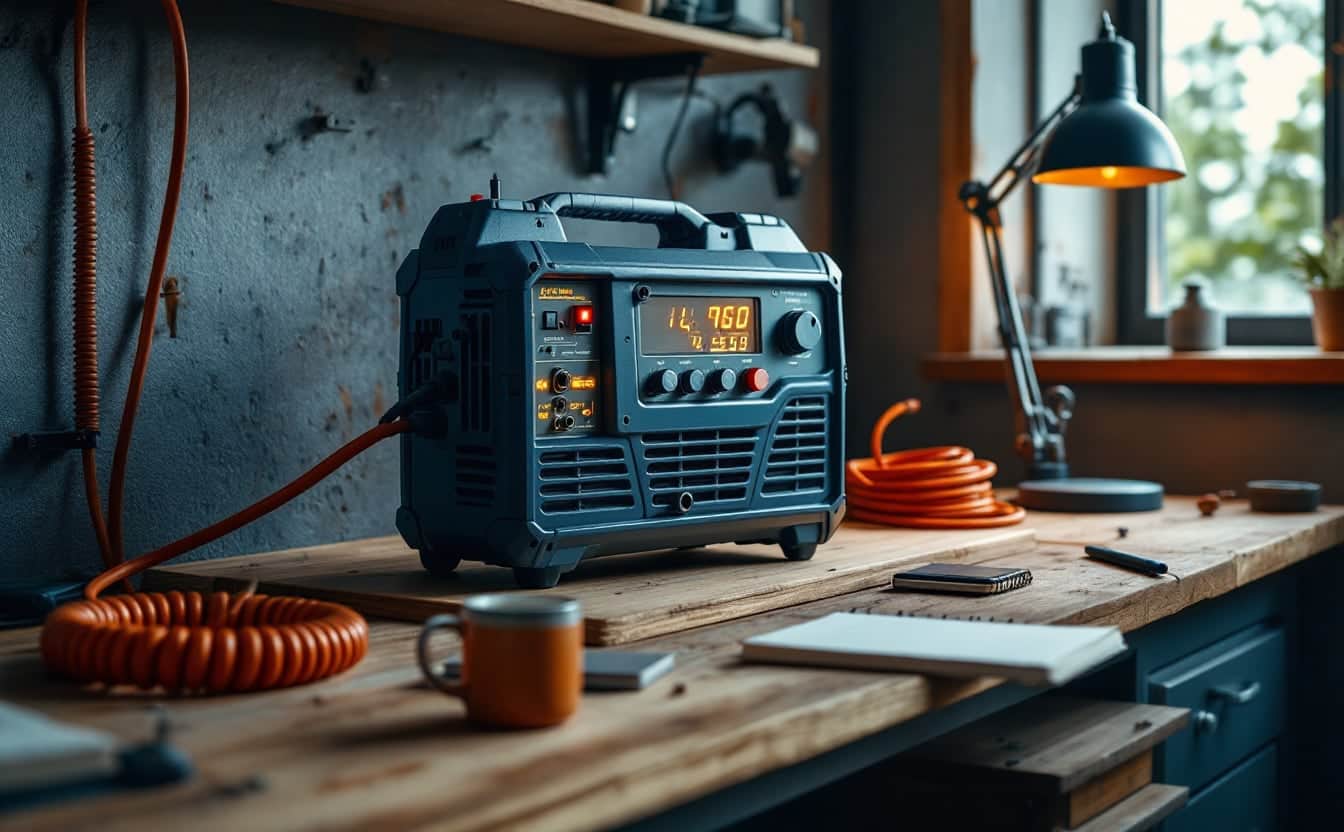
A "1000W" portable power station usually means a unit with about 1 kWh of battery, 1,000 to 1,150 Wh, behind an inverter that delivers 1,500 to 1,800 W, so read both numbers before you buy. That class runs a refrigerator for roughly 18 to 20 hours, a home office through a working day, or a router and modem for about 41 hours, but a 1,500 W space heater for only about 36 minutes. For most people the right choice is a LiFePO4 unit with a UPS mode, and the three worth comparing first are the Jackery Explorer 1000 v2, the Anker SOLIX C1000 and the BLUETTI AC180.
Ready list

Jackery Explorer 1000 v2 1,070 Wh LiFePO4
About 1 kWh of LiFePO4 storage and a 1,500 W inverter: a laptop, router, phone chargers and a lamp through a full working day.
$499.00 Checked on Amazon Oct 23, 2026, 4:26 PM UTC Product prices and availability are accurate as of the date/time indicated and are subject to change.

Anker SOLIX C1000 1,056 Wh LiFePO4
1 kWh LiFePO4 with a pass-through UPS mode that keeps a laptop, router and monitor going when the mains drops.
$499.99 Checked on Amazon Oct 23, 2026, 4:26 PM UTC Product prices and availability are accurate as of the date/time indicated and are subject to change.

BLUETTI AC180 1,152 Wh LiFePO4
A middle size for a small office: 1,152 Wh of LiFePO4 and enough output for a fridge or a coffee maker.
$449.00 Checked on Amazon Oct 23, 2026, 4:26 PM UTC Product prices and availability are accurate as of the date/time indicated and are subject to change.
Chosen from manufacturer specifications and published reviews, not tested by us. The full Readiness kit
Watts and watt-hours are different numbers
Watts (W) are a rate: how much power the station can hand out at one moment. Watt-hours (Wh) are a store: how much energy sits in the battery. Think of the watt rating as the width of a tap and the watt-hour rating as the size of the tank.
The confusion has history. Jackery's original Explorer 1000, a lithium-ion model, paired 1,002 Wh of battery with a 1,000 W inverter, so the name described both figures at once. Its successor, the Explorer 1000 v2, keeps about the same battery (1,070 Wh) but raises the output to 1,500 W. A station called "1000" now often has more than 1,000 W of output, while a unit sold on its 1,000 W output can hold far less than 1,000 Wh. The watt-hour line decides how long anything runs.
Not all of the stored energy reaches your devices. Our power station runtime calculator takes 85 percent of the rated capacity as usable, after inverter and battery losses, so a 1,070 Wh station delivers about 910 Wh at its AC outlets. Here is what that means at a steady load:
| Steady load | Example | Runtime on 1,070 Wh |
|---|---|---|
| 100 W | A laptop, a 24 in monitor and a router together | About 9 h 6 min |
| 500 W | A gaming desktop and monitor under heavy load | About 1 h 49 min |
| 1,000 W | A microwave on full power | About 55 min |
| 1,500 W | A space heater on high | About 36 min |
The last row surprises people: a station that can deliver 1,500 W can run a 1,500 W heater, but empties itself in about half an hour.
Start with the requirement: what must run, at once and over a day
Before comparing models, write down two things.
- The biggest moment. Which devices could be on at the same time, and what do their watts add up to? That total has to sit below the station's continuous output, with room to spare.
- The day. Each device's watts times the hours it runs, added up. That total, divided by 0.85, is the capacity you need for one day without recharging.
Take wattages from a plug-in power meter if you can, because labels give the maximum draw, not the typical one. For a refrigerator or freezer, the yellow EnergyGuide label is a better guide than the nameplate: divide its yearly kWh figure by 365 for a daily figure in kWh.
Readiness kit
- Jackery Explorer 1000 v21,070 Wh LiFePO4Shop on Amazon
- Anker SOLIX C10001,056 Wh LiFePO4Shop on Amazon
- BLUETTI AC1801,152 Wh LiFePO4Shop on Amazon
As an Amazon Associate I earn from qualifying purchases. All picks
What a 1 kWh class station runs, and for how long
These four cases come from the runtime calculator at 85 percent efficiency, on the published capacities of the three main picks. The figures are days covered: 1.0 means the station lasts the full daily pattern.
| Case | Loads | Energy per day | Jackery 1,070 Wh | Anker 1,056 Wh | BLUETTI 1,152 Wh |
|---|---|---|---|---|---|
| Refrigerator alone | 150 W for 8 h of compressor time | 1,200 Wh | 0.76 (about 18 h) | 0.75 (about 18 h) | 0.82 (about 19.5 h) |
| Laptop workday | Laptop 60 W and monitor 25 W for 8 h, router and modem 22 W for 10 h, phone 3 h | 930 Wh | 0.98 | 0.97 | 1.05 |
| Storm evening at home | Three 10 W lamps for 6 h, a 50 in TV for 4 h, two phones, router and modem all day | 1,088 Wh | 0.84 | 0.83 | 0.90 |
| Fridge plus internet | The fridge, router and modem all day, two lamps for 6 h | 1,848 Wh | 0.49 | 0.49 | 0.53 |
A laptop workday fits the class almost exactly, with nothing left for the evening. The refrigerator alone takes most of the battery, so the fridge plus the internet lasts about half a day. If keeping food cold is the main reason you are buying, a 1 kWh station buys time rather than a full day, unless you can recharge from solar panels or a car. The fridge line uses the calculator's preset, 150 W for 8 hours of compressor time a day; check yours against its EnergyGuide label.
Short, heavy loads are fine while they stay short. A 900 W coffee maker running for 15 minutes uses 225 Wh, a quarter of what the station delivers, and ten minutes of a 1,000 W microwave about 167 Wh. Each costs hours of fridge or router time later.
Continuous output and surge
Continuous output is what the inverter can hold for as long as the battery lasts. Surge is a short peak it covers for a moment, and it matters for anything with a motor: fridge and freezer compressors and pumps draw several times their running watts at start-up. If that peak goes over the surge rating, the station cuts its outlets. The makers' surge figures are 3,000 W for the Jackery Explorer 1000 v2 (its manual), 2,400 W for the Anker SOLIX C1000 (its datasheet) and 2,700 W for the BLUETTI AC180 (its product page).
Anker's SurgePad and BLUETTI's Power Lifting are boost modes for high-wattage appliances; BLUETTI lists its 2,700 W Power Lifting figure for heating devices. Modes of this kind are meant for resistive loads such as kettles and hair dryers, and do not help a motor start. Your unit's manual says which appliances its mode supports.
The practical test: before an outage, run the fridge on the charged station through several compressor cycles. If it trips, you learn that on an ordinary afternoon rather than during a storm.
LiFePO4 or NMC
Older units used NMC (nickel manganese cobalt) cells, usually listed simply as lithium-ion. Most current 1 kWh models use lithium iron phosphate, written LiFePO4 or LFP. The trade-off, as the makers describe it:
- Cycle life. LiFePO4 is quoted in thousands of cycles: 4,000 to 70 percent or more of capacity for the Jackery Explorer 1000 v2, 3,000 or more to 80 percent for the Anker SOLIX C1000, and 3,500 or more to 80 percent for the BLUETTI AC180. NMC units were commonly quoted at a few hundred to about a thousand.
- Weight. NMC stores more energy per pound. The gap has narrowed: Jackery's original NMC Explorer 1000 weighed about 22 lb (10 kg), while the LiFePO4 v2 weighs about 23.8 lb. The Anker weighs 28.4 lb and the BLUETTI 35.3 lb, which counts if the unit goes up and down stairs.
- Heat. Makers describe LiFePO4 as the more thermally stable chemistry, which suits a box that lives in a closet for years.
Neither likes charging in the cold: Anker gives a recharging range of 32 to 104°F (0 to 40°C) for the C1000, so a station kept in an unheated garage may need to come indoors to refill in winter. For backup gear kept for years, LiFePO4 is the sensible default.
The three picks side by side
| Spec | Jackery Explorer 1000 v2 | Anker SOLIX C1000 | BLUETTI AC180 |
|---|---|---|---|
| Capacity | 1,070 Wh | 1,056 Wh | 1,152 Wh |
| Continuous AC output | 1,500 W | 1,800 W | 1,800 W |
| Surge (maker's figure) | 3,000 W | 2,400 W | 2,700 W |
| Chemistry and cycles | LiFePO4, 4,000 to 70% | LiFePO4, 3,000 to 80% | LiFePO4, 3,500 to 80% |
| UPS switchover | Under 20 ms | Under 20 ms | 20 ms |
| Weight | About 23.8 lb | 28.4 lb | 35.3 lb |
| Solar input | Up to 400 W | Up to 600 W | Up to 500 W |
| Fast wall recharge | Emergency mode in the app; check the time on the spec sheet | 58 min to full | About 45 min to 80% |
| Expansion | None | To 2,112 Wh | To 4,224 Wh |
Which one to buy
The Jackery Explorer 1000 v2 is the lightest and simplest, with the highest surge figure. Its 1,500 W output is the lowest here, so it suits a desk, a fridge and lights more than a busy kitchen, and it cannot add batteries.
The Anker SOLIX C1000 is the all-rounder: 1,800 W, a 58 minute full recharge by Anker's figure, the largest solar input of the three and expansion to 2,112 Wh. For a home office that wants a UPS mode in front of the router and laptop, start here.
The BLUETTI AC180 holds the most energy and expands furthest, to 4,224 Wh, but is the heaviest. Pick it if the fridge is the reason you are buying, and buy direct from BLUETTI for solar or battery bundles. EcoFlow lists the DELTA 3 Plus at 1,024 Wh and 1,800 W, with a switchover under 10 ms and expansion to 5 kWh.
A note on method: this shortlist comes from manufacturer specification sheets, product pages and published reviews. We did not test these stations ourselves, so confirm capacity, output and switchover time on the maker's current page before you order.
Readiness kit
| Category | Pick | Why it is on the list | Link |
|---|---|---|---|
| Power station, 1 kWh | Jackery Explorer 1000 v2 | About 1 kWh of LiFePO4 storage and a 1,500 W inverter: a laptop, router, phone chargers and a lamp through a full working day. | Shop on Amazon |
| Power station with UPS mode | Anker SOLIX C1000 | 1 kWh LiFePO4 with a pass-through UPS mode that keeps a laptop, router and monitor going when the mains drops. | Shop on Amazon |
| Power station, 1.1 kWh | BLUETTI AC180 | A middle size for a small office: 1,152 Wh of LiFePO4 and enough output for a fridge or a coffee maker. | Shop on Amazon |
| Power station, expandable | EcoFlow DELTA and RIVER stations | Fast AC recharging, and the larger DELTA units take add-on batteries when a site needs more hours. | Go to EcoFlow |
| Power station, direct | BLUETTI AC180 and AC series | LiFePO4 stations bought from the maker, with solar panel bundles and add-on batteries for longer outages. | Go to BLUETTI |
A 1000W station checklist
- Read the Wh figure first, then the W figure.
- Add up what could run at once and keep it below the continuous rating.
- Check the surge figure if a fridge, freezer or pump is on the list, then test it at home.
- Choose LiFePO4 for a unit you will keep for years.
- If a computer will sit on it, check that a UPS mode is listed with a switchover time.
- Know how you will refill it: wall time, solar input in watts, a car socket.
- Charge it every few months, and keep it indoors in winter.
Where 1 kWh runs out
A 1 kWh station suits one person's working day, or a fridge for part of a day. It is the wrong size for a fridge and a freezer through a full day, for anything that heats, or for a whole household. For those, step up to the 2 kWh class or an expandable system; our guide to the best portable power station for home backup compares the sizes.
A 20 ms switchover can be too slow for some desktop power supplies, so put a desktop PC on a conventional unit from our UPS battery backup guide and let the station carry the long hours. For wells, sump pumps and heating fans, size a generator with our generator size calculator.
Sources
- Jackery Explorer 1000 v2 user manual, and the data sheet for the original Explorer 1000.
- Anker SOLIX C1000 datasheet (model A1761).
- BLUETTI AC180 product page.
- EcoFlow US product page for the DELTA 3 Plus.
- Goal Zero and Anker SOLIX explainers on LFP and NMC battery chemistry.
- U.S. Department of Energy, Energy Saver: "Estimating Appliance and Home Electronic Energy Use."
- Ready.gov: Power Outages
Kit check
- Jackery Explorer 1000 v2 1,070 Wh LiFePO4Shop on Amazon
- Anker SOLIX C1000 1,056 Wh LiFePO4Shop on Amazon
- BLUETTI AC180 1,152 Wh LiFePO4Shop on Amazon
Frequently asked questions
What is the difference between 1000W and 1000Wh?
1,000 W is how much power a station can deliver at one moment. 1,000 Wh is how much energy its battery holds. A station with 1,070 Wh delivers about 910 Wh at its outlets, enough for a 100 W load for about 9 hours or a 1,000 W load for about 55 minutes.
Will a 1000W portable power station run a refrigerator?
Most 1 kWh class units will, if their surge rating covers the compressor's start-up. Using the calculator's fridge preset, 150 W for 8 hours a day, a 1,070 Wh station keeps a fridge going for about 18 hours. Test it at home first, and keep the door closed during an outage.
How long does a 1000W power station last?
It depends on the load, not the watt rating. With about 1 kWh of battery it runs a laptop workday with the internet on, a router and modem for about 41 hours, or a refrigerator for most of a day. A 1,500 W heater empties it in about 36 minutes.
Is a 1000W power station enough for home backup?
For a home office and the internet, usually yes. For a fridge plus the rest of the house through a full day, no: plan for 2 kWh or more, an expansion battery, or a way to recharge every day.