
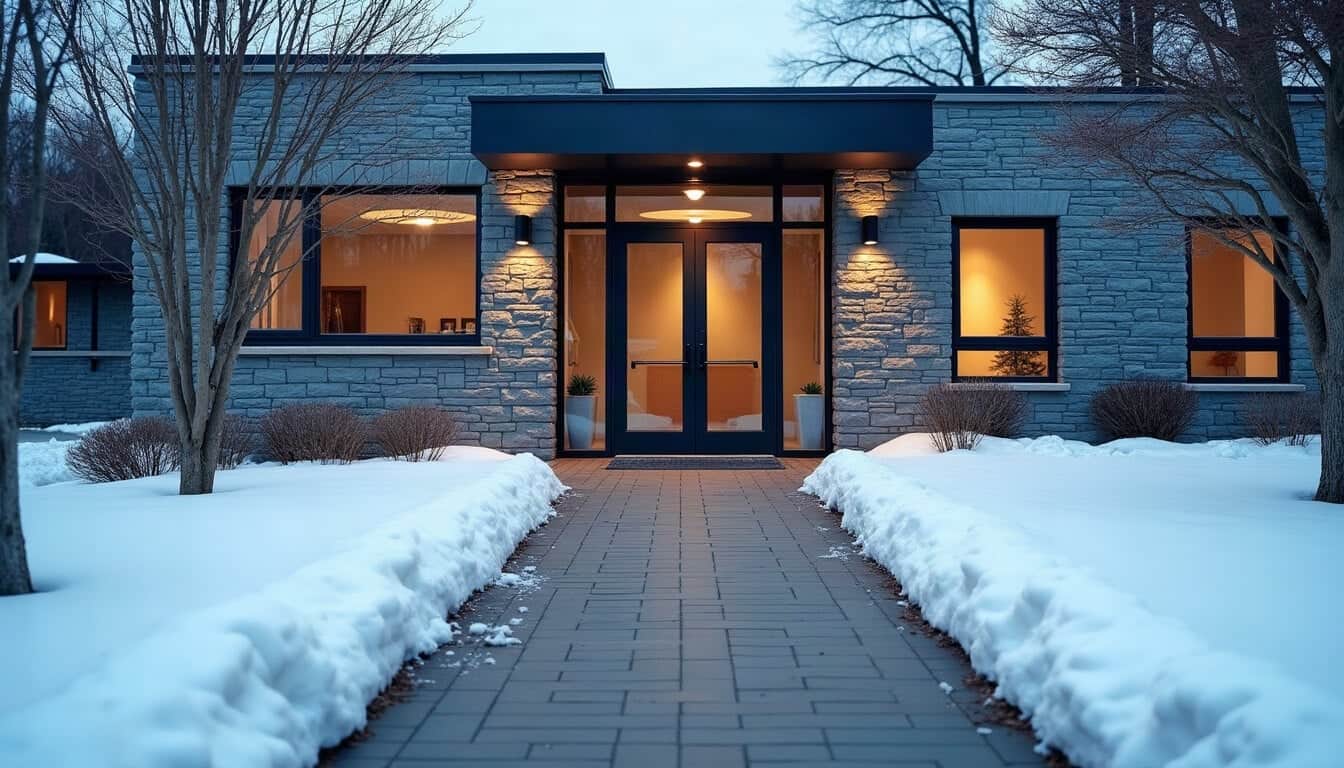
The call comes a little after six on the first hard morning of winter. Overnight the melt from yesterday's sun ran across the front walk, pooled by the door and froze into a sheet. The first employee to arrive slipped on it, the deliveries are waiting at the curb, and nobody wants to open the doors until someone has dealt with the ice.
Planning outdoor work is easier in summer than in January, and anyone weighing hardscaping Appleton projects for a shop, office or home should treat walkways, steps and retaining walls as part of the winter plan rather than as decoration. This insight walks through the outdoor exposures we see most often in snowy, freeze-and-thaw country, and what to put in place before the ground goes hard.
Ice that forms where water has nowhere to go
Exposure. Most winter slip hazards are not caused by snowfall. They are caused by water. A walk that dips in the middle, a patio that pitches toward the building, or a downspout that empties across a path will collect meltwater on a sunny afternoon and turn it into ice by evening. The same spot freezes again every night for weeks.
Impact. The obvious cost is an injury to a staff member, a customer or a delivery driver. The quieter cost is that the business starts each day late. Someone has to arrive early to salt and chip, the main entrance gets roped off, and visitors are sent around to a side door that was never meant for them. At home, the same patch can keep an older relative indoors for most of the season.
Control. Surfaces that shed water away from the door, toward ground that can take it. That means correct pitch, a sound base under the pavers or slab, and a sensible place for roof water to go. A hardscaping contractor can look at the whole approach, from the parking area to the threshold, and rework the grades so the low spot stops being a low spot. Salt and sand are the response; drainage is the control.
Test. On the next mild afternoon after a snowfall, walk the main route with a phone camera and note every place where water stands. Go back at dusk. Anything still wet when the light goes is where tomorrow's ice will be.
Steps and slabs lifted by frost
Exposure. In cold climates the ground moves. Water in the soil under a step or slab freezes, expands and lifts it, then lets it down unevenly in spring. Over a few winters a smooth walk turns into a series of small ledges, and a set of front steps starts to rock or pull away from the building.
Impact. A raised edge of even a small height is enough to catch a toe, especially in boots and in poor light. Doors that swing outward can start to bind on a lifted slab, which matters a great deal if that door is a fire exit. For a small business, an uneven entrance is also the kind of thing a visitor remembers.
Control. Most frost damage traces back to what was done below the surface: the depth and type of base, how well it was compacted, and whether water can drain out of it. This is work for a professional who installs patios and walkways in your climate, not a weekend project. When you get a quote, ask how the base will be built and how water will leave it. A good contractor will explain that plainly.
Test. Each spring, after the frost is out, walk every exterior door and step with a straight edge, even a long level laid flat. Note any lip, gap or rocking step and have it looked at before autumn, not after the first freeze.
Single point of failure: for many small sites it is the one front walk that staff, customers and deliveries all share. If ice or a heaved slab closes it, the business is effectively closed, so that route deserves the best drainage and the soundest base on the property.
A retaining wall that holds more than soil
Exposure. On sloped lots, retaining walls do quiet work. They hold up the edge of a parking area, keep a path level, or stop a bank from sliding onto a patio. Saturated soil in spring, frost pressure in winter and poor drainage behind the wall all push against it. The early signs are easy to miss: a slight lean, blocks shifting out of line, soil washing out at the base, water seeping through the face after rain.
Impact. A wall that fails does not just make a mess. It can take a section of parking, a walkway or an access route out of service at once, and it can be dangerous to anyone nearby when it goes. Repairs to a failed wall are usually larger and slower than work done when the first signs appeared.
Control. Any wall that holds back a slope, supports a driveway or sits near a building is a job for an experienced installer. The design of drainage behind the wall, the base and the way the courses are tied back is what keeps it standing through freeze and thaw, and none of that is something to improvise. If a wall is already leaning, keep people and vehicles away from it and get a professional to assess it.
Test. Photograph each retaining wall from the same spot every spring and autumn. Compare the pictures side by side. Movement that is hard to see from one visit to the next is often obvious across a year.
Snow storage, second exits and the place people gather
Exposure. Plowing pushes snow somewhere, and that somewhere is often the side path to the rear exit, the drain inlet, or the patch of patio that doubles as the outdoor assembly point in an evacuation. By midwinter the second way out is buried, and the meltwater from the pile runs straight back across the walk you just cleared.
Impact. In a fire alarm or a gas smell, staff need two ways out and a safe, clear place to stand and be counted. If the rear door opens onto a snowbank and the gathering spot is under a drift, the evacuation plan only exists on paper. For a household, the same applies to the back door and the route to the driveway.
Control. Decide where snow will go before the first storm, and make sure it is downhill of walkways and away from exits and drains. Where the layout makes that impossible, changes to paving, steps or a small patio can create a dedicated, well-drained assembly area and a clear second route. Agree on the snow plan with whoever plows the lot so it survives a change of crew.
Test. After the first real snowfall, run a short evacuation walk-through. Every person leaves by the nearest exit and walks to the assembly point. If anyone has to climb, wade or detour, fix the route before the next storm.
Working with the season, not against it
Outdoor work in this part of the country has a calendar. Excavation and base work need unfrozen ground, and the best contractors book up well before autumn. That makes hardscaping one of the few continuity controls where waiting until the problem appears guarantees you will live with it for another winter.
A simple way to plan it:
| When | What to do |
|---|---|
| Spring | Walk every route, photograph walls, note heaved slabs and ponding spots |
| Early summer | Get assessments and quotes; schedule work for the dry months |
| Late summer to autumn | Complete repairs and drainage changes; agree the snow storage plan |
| Winter | Monitor, salt and clear; log new problem spots for next spring |
Coordinate anything that touches a public sidewalk, a shared drive or a drainage easement with your municipality first. Local officials decide what can be changed there, and some work needs their approval.
What to do this quarter
- Walk the main entrance route at dusk after a melt and mark every place water stands or ice forms.
- Name one person who owns the outdoor access plan, including snow storage, the second exit and the assembly point.
- Book an assessment for any heaved step, ponding walk or leaning wall while there is still time to schedule work before the ground freezes.
The front walk is not glamorous, but it is the first thing every plan assumes will be there in the morning.