At 12:33 local time on 28 April 2025 (11:33 in Portugal), the power systems of mainland Spain and Portugal collapsed within seconds. Spain lost 25,638 MW of demand and Portugal 5,900 MW, in both cases all of it, according to the final report of the European expert panel that investigated the event. Beyond a brief disturbance near the border in southwest France, the rest of Europe's grid was unaffected. Portugal's transmission grid was fully restored by 00:22 the next morning and Spain's by 04:00, roughly 12 and 16 hours after the collapse.
ENTSO-E, the association of European grid operators, called it the most severe blackout on the European system in more than 20 years and the first of its kind there, driven by overvoltage. For businesses the lesson is plainer: card payments, mobile networks, trains, traffic lights and fuel pumps failed together. Plan for a day without any of them.
What happened
From ENTSO-E's factual report (October 2025) and final report (March 2026), in Spanish local time:
| Time | Event |
|---|---|
| 12:03 to 12:22 | Two episodes of power oscillation, the second between Iberia and the rest of Europe |
| Before 12:32 | Spanish and French operators damp the oscillations by switching lines in and reducing the flow between Spain and France. Voltages rise, still within limits |
| 12:32:57 | A generator transformer near Granada trips on overvoltage protection, taking 355 MW off the grid |
| 12:33:16 to 12:33:18 | Further trips in Badajoz (about 725 MW), then in Segovia, Huelva, Badajoz, Seville and Cáceres (about 930 MW or more) |
| 12:33:19 | Frequency falls and the Iberian system loses synchronism with Europe. Automatic load shedding starts in both countries but cannot stop a collapse driven by overvoltage |
| 12:33:21 | AC lines from Spain to France and Morocco disconnect |
| Afternoon | Spain restarts with help from France, Morocco and black-start plants; Portugal from two black-start plants |
| 00:22, 29 April | Portugal's transmission grid fully restored |
| 04:00, 29 April | Spain's transmission grid fully restored; Red Eléctrica reports 99.95 percent of demand supplied by 07:00 |
What the investigations found, and where they disagree
The Spanish government's report, presented on 17 June 2025, ruled out a cyberattack. It concluded that the system lacked enough voltage control capacity, either because too little was scheduled or because scheduled plants did not deliver what the rules required, or both, and pointed to shortcomings at the grid operator and at generators.
Red Eléctrica, Spain's grid operator, replied the next day that its planning had provided enough voltage control, that conventional plants paid to regulate voltage did not do so as required, and that some installations disconnected improperly. Aelec, the association of large Spanish utilities, rejected that account and placed responsibility on the operator.
ENTSO-E's expert panel of 49 grid operator and regulator experts, led by two from operators that were not affected, published its final report on 20 March 2026. It found no single root cause but a combination of interacting factors. Its root cause tree includes conventional generators whose voltage support was not effective, renewable plants running at a fixed power factor that did not respond to voltage changes, voltage control reactors that had to be switched by hand and could not all be connected in time, and protection settings that diverged from requirements. The panel says plainly that it does not allocate liability, which is for national authorities.
In short, the reports agree on the physics, a fast voltage rise that tripped generation in a cascade, and differ on who should have prevented it. For a planner, the pattern matters more than the blame: a grid can fail in a way its operators had not seen before, in seconds, across two countries.
What failed for businesses
- Payments. ATMs and card terminals went down with power and networks. A September 2025 article in the European Central Bank's Economic Bulletin found that ATM withdrawals in the affected areas plummeted that day because the machines were offline.
- Telecoms. Calls failed on some mobile networks. ENTSO-E's final report records that public telecom networks lost coverage as backup power at repeaters and switching centers gave out, and some distribution companies restoring the grid fell back on satellite phones. In regions without that backup, including Galicia, Seville, Barcelona and Madrid, reconnecting customers was significantly delayed.
- Transport. Trains and metro systems stopped and traffic lights went dark. Spanish emergency services rescued about 35,000 passengers stranded on trains and underground. Airports stayed open on backup generators, but hundreds of flights were canceled across both countries, and many commuters walked for hours or hitchhiked home.
- Public order and safety. Spain's Interior Ministry declared a national emergency in regions that asked for it, including Madrid, Andalusia and Extremadura. Spanish media reported that three members of one family in Galicia died of carbon monoxide poisoning from a generator running inside their home.
Like the CrowdStrike outage of July 2024, it showed how one shared system failing reaches everything built on top of it.
Lessons for your continuity plan
Payments and cash
Decide in advance what happens at a till when cards fail: close, take cash only, or record sales for later settlement with known customers. Keep a cash float for a day of essentials, a printed price list and a paper sales log, and ask your payment provider whether terminals have an offline mode and who carries the risk on it.
Telecoms run on grid power
A UPS keeps your router alive, but cell sites and exchanges beyond your building run on batteries sized for hours. Agree a default for when nobody can be reached: staff go home, or to a named site, and check in at a set time. Give the incident team at least one channel that does not depend on the public network, such as two-way radios on site or satellite messaging for a dispersed team.
Transport and getting staff home
When trains and traffic lights stop at lunchtime, the hardest call is whether to send people home or keep them. Release staff in groups, earliest for those with long journeys, children to collect or health needs, and pair up people heading the same way. Keep the office open as a shelter for anyone who cannot get home, with water, light and a way to charge phones. Staff with supplies at home worry less, so share our emergency kit for home checklist with them.
Cold chain
FoodSafety.gov advises that a closed refrigerator keeps food safe for about 4 hours, and a full freezer about 48 hours (24 if half full) with the door shut. Half a day without power is past the first limit. Decide who keeps doors closed, who logs temperatures with a battery thermometer, and when stock is moved or written off. Medicines follow their own storage rules, not food guidance.
Backup power and fuel
Size backup power for 12 to 16 hours, not for the few minutes your UPS was bought for. A generator needs fuel on site, because filling station pumps need power too, and must cover running loads plus the largest motor start; our generator size calculator does the arithmetic. The Galicia deaths make the official guidance from CDC and Ready.gov painfully concrete: generators outdoors only, at least 20 feet from doors, windows and vents, carbon monoxide alarms inside, and any connection to building wiring through a transfer switch installed by a licensed electrician.
For a reception desk or small office, a portable power station is often enough. Running a router and fiber terminal for 16 hours, one laptop for 8 hours, four phone charges and two LED lamps for 6 hours uses 1,072 Wh, which at 85 percent efficiency calls for about 1,260 Wh of battery. The power station runtime calculator works it out for your own devices, and our guide to the best portable power station for home backup compares size classes. The router only helps while the network beyond it is up.
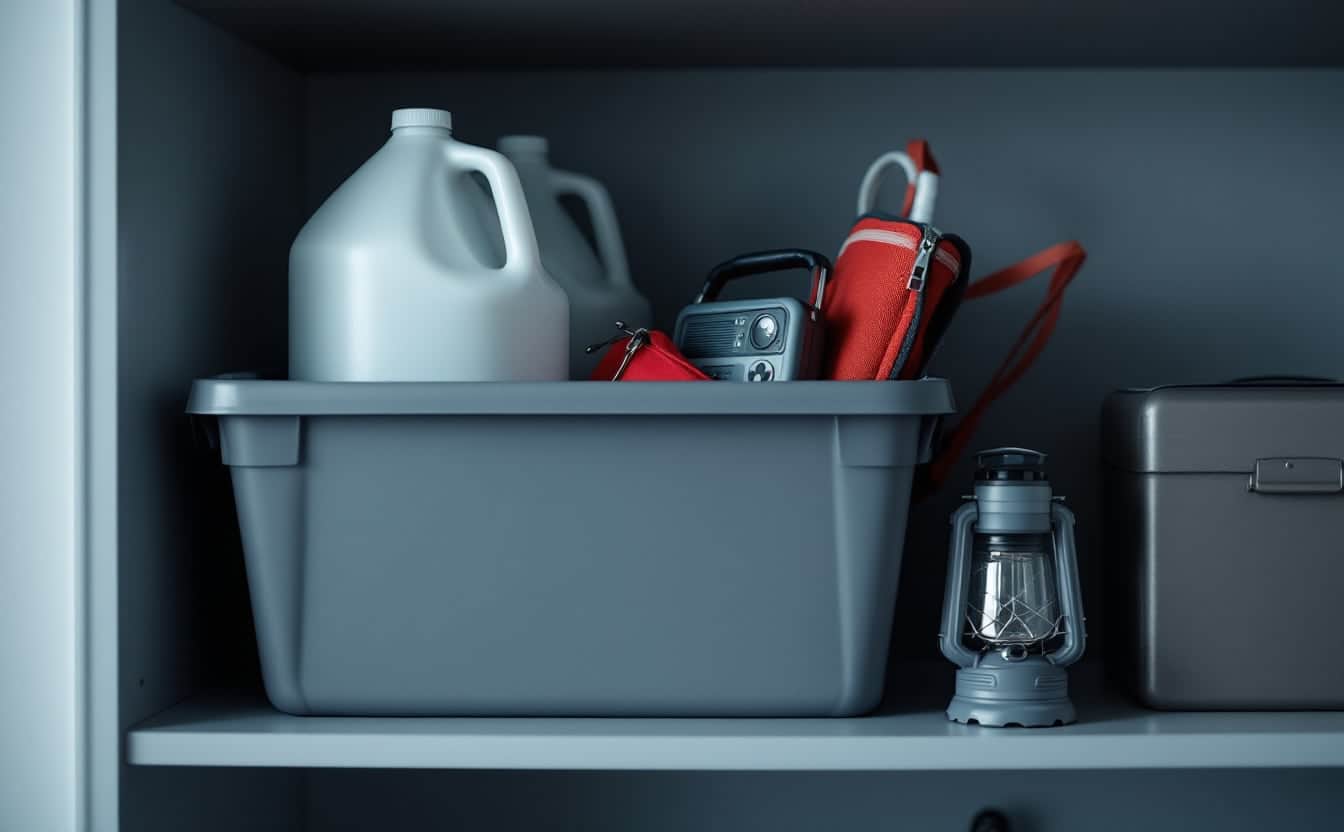
For the desk drawer, three small items earn their place: a crank or solar radio, a lantern and a travel power bank.
A radio that runs on a crank or the sun answers the question every office asked that afternoon: what is going on, and when will it end?
Plan before a regional outage
Write the scenario down: a regional blackout of 12 to 24 hours with patchy mobile service, no card payments, no public transport and no fuel from pumps. Then settle the decisions that cannot wait for a phone call:
- Who decides to close, release staff or shelter them, and by what time.
- The default instruction for staff who cannot reach anyone.
- What each site does with cash, chilled stock and open orders.
The grid alert triggers in our extreme heat and grid stress playbook and the time-phased checklists in our hurricane readiness guide both carry over. But the Iberian blackout came with no forecast, on a clear spring day at lunchtime. The plan had to be ready already.
Sources
- ENTSO-E, 28 April 2025 Blackout: expert panel factual report (3 October 2025) and Final Report on the Grid Incident in Spain and Portugal on 28 April 2025 (20 March 2026).
- Red Eléctrica, "Red Eléctrica's response to the incident of 28 April," April 2025, and its analysis of 18 June 2025.
- Government of Spain, report presented to the Council of Ministers on 17 June 2025, as reported by Bloomberg and pv magazine; Red Eléctrica's and Aelec's positions as reported by The Local and Ara, 18 June 2025.
- Associated Press, 28 April 2025, on transport, ATMs and phone service; AP and Euronews on rescued train passengers, airports and commuters; Reuters on the emergency declaration; The Local on the generator deaths in Galicia.
- European Central Bank, "Keep calm and carry cash," Economic Bulletin Issue 6, 2025.
- FoodSafety.gov guidance on food during a power outage.
Frequently asked questions
What caused the 2025 blackout in Spain and Portugal?
ENTSO-E's expert panel found no single cause. A fast voltage rise set off a cascade of generator disconnections in southern Spain, and the system went down about 24 seconds after the first major trip. Spain's government, its grid operator and its large utilities disagree about who was responsible.
How long did the Iberian blackout last?
Power went out at 12:33 local time on 28 April 2025. Portugal's transmission grid was fully restored by 00:22 on 29 April and Spain's by 04:00, and Red Eléctrica reported 99.95 percent of Spanish demand supplied by 07:00. Many areas had power back sooner.
Was the blackout caused by renewable energy?
The investigations do not support a single-technology explanation. ENTSO-E's root cause tree includes renewable plants at a fixed power factor that did not help control voltage, but also conventional plants whose voltage support was not effective, manual switching and protection settings out of line with requirements.
How should a business prepare for a regional blackout?
Plan for 12 to 24 hours without power, mobile service, card payments or public transport. Settle in advance who decides to release or shelter staff, how you trade without cards, how you protect chilled stock, and how much fuel and battery capacity you hold, then practice it on a normal day.