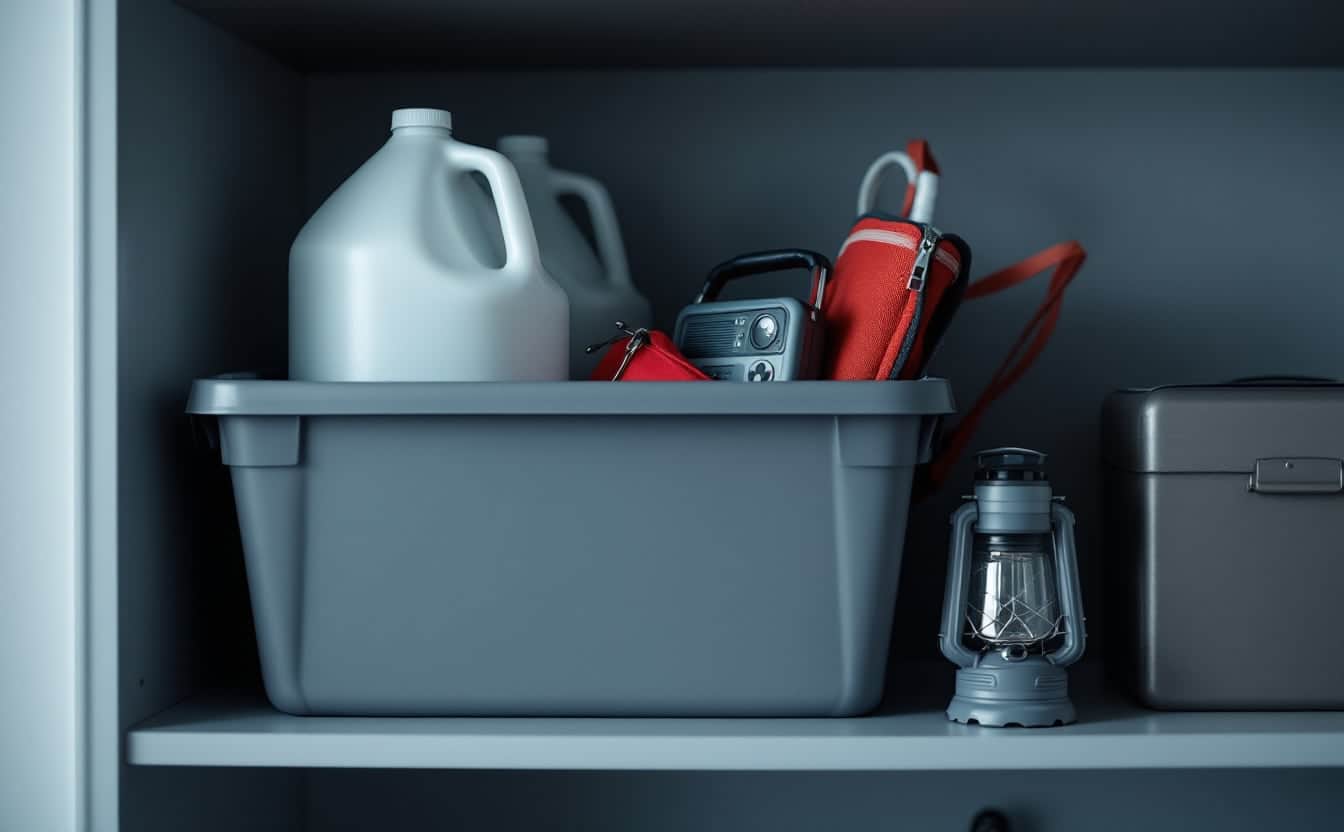
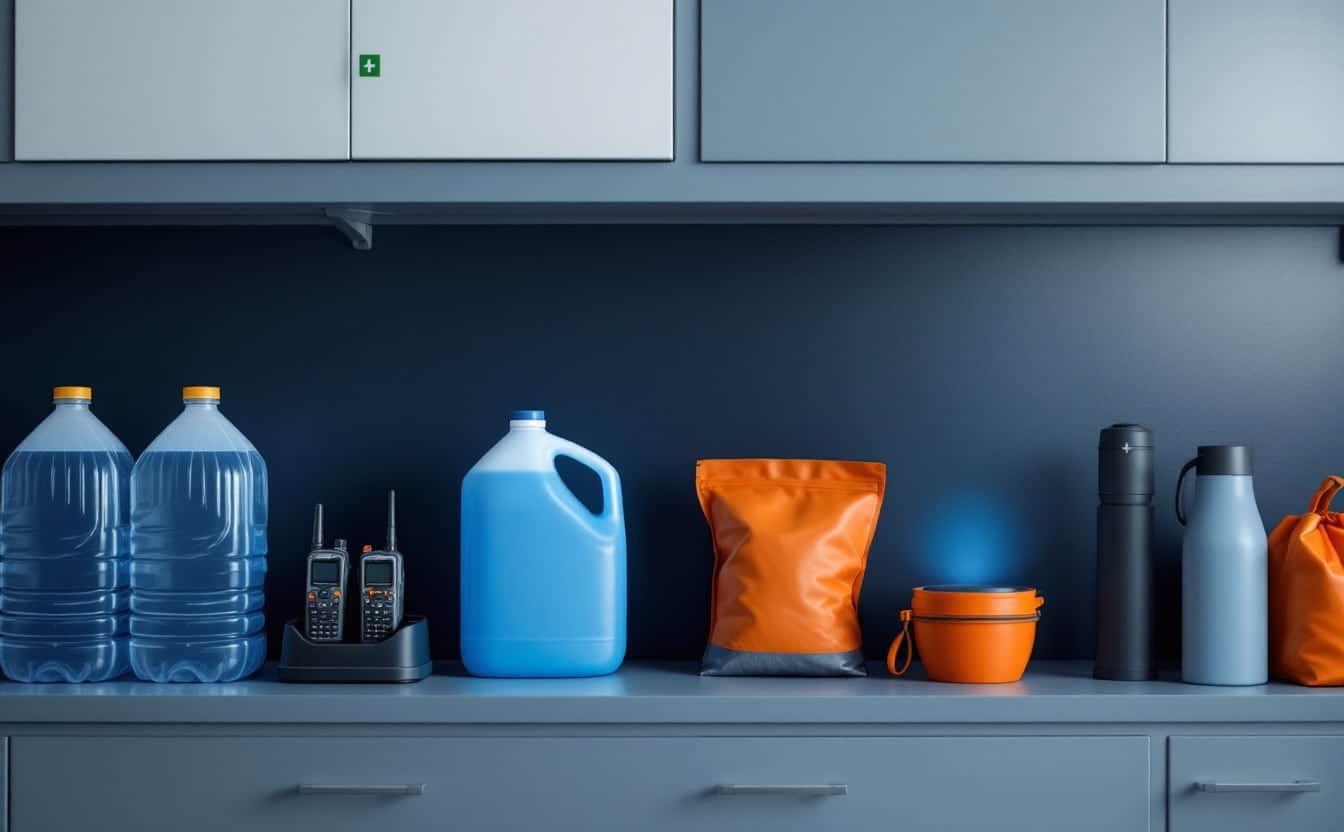
An emergency preparedness kit for an office is really four smaller kits, each kept where it will be used: a bag for every floor warden, a kit at reception, shelter-in-place stores in the rooms where people would wait out a storm or a chemical release, and a stocked first aid station on each floor. Ready.gov's benchmark for the workplace is being ready to shelter at work for at least 24 hours, so the core is water at one gallon per person per day, food, light, a radio and first aid. For a 50-person office, that is 50 gallons of water for a single day.
A home kit, covered in emergency kit for home, serves a family that knows where everything is. An office kit serves people who may never have opened the supply closet, plus visitors and contractors, and it sits inside a legal frame: OSHA's first aid rule and, for many workplaces, a written emergency action plan.
Workplace emergency preparedness starts with the plan
The kit follows the plan. Ready.gov's guidance on business emergency response plans asks employers to develop protective actions for life safety (evacuation, shelter, shelter-in-place and lockdown) and to define the most appropriate one for each hazard. Two of them shape the supplies:
- Evacuation needs things that travel: lights, radios, rosters and a first aid kit that can go to the assembly point.
- Shelter-in-place needs things that stay: water, food, sealing materials and a way to hear official updates.
If nobody has yet written down who orders each action and how people are told, start with our emergency action plan template, built on OSHA's 29 CFR 1910.38.
Where the kit lives: four stations
| Station | Where | Owner | Built for |
|---|---|---|---|
| Warden bags | A hook by each stair door or at each warden's desk | Each warden and an alternate | Clearing a floor, the head count |
| Reception kit | Front desk or security desk | Receptionist or security lead | Alerts, visitors, the first call to responders |
| Shelter stores | Inside or beside each shelter room | Facilities | Staying put for 24 hours or more |
| First aid station | Every floor, plus each higher-risk area | A named first aid lead | Injuries in the first few minutes |
Floor warden bags
OSHA's evacuation eTool suggests that one warden for every 20 employees should be adequate, with enough wardens available during all working hours. Wardens check offices, restrooms and other spaces before leaving, make sure fire doors are closed, help visitors and anyone who needs assistance, and know the alternate routes. A 100-person office therefore needs about five bags, and the bags should hang at the stations so an alternate can grab one on a day the warden works from home.
Each bag holds what one person needs to clear an area and report:
- A high-visibility vest, so people know whom to follow.
- A flashlight or headlamp, with spare batteries.
- A charged FRS two-way radio and a card with the primary and backup channels.
- A printed floor plan with exits, areas of refuge and the assembly point marked.
- A floor roster refreshed each month, a pen and a marker for doors already checked.
- A whistle and a few dust masks, both on Ready.gov's basic supplies list.
- Nitrile gloves, a small first aid kit and a foil blanket.
- A small power bank and a charging cable for the warden's phone.
Our best weather radio guide covers FRS channels, range and licensing.
The reception kit
Reception sees every visitor and usually meets the responders first. Keep these within reach:
- A weather alert radio programmed for your county, so warnings sound even when no one is watching a screen.
- A way to produce the day's visitor list with no network: a printout at noon or a charged tablet with the log cached.
- A battery lantern and a travel power bank.
- A printed call sheet: building management, security, the alarm company, utilities, the incident lead and alternates.
- Instructions for switching the main line to call forwarding and changing the greeting. OSHA's shelter-in-place steps include both, so callers learn the office is closed and people are staying inside.
Shelter-in-place supplies by headcount
OSHA's shelter-in-place guidance, written for chemical, biological or radiological releases, sets out the room and the supplies. Pick interior rooms above the ground floor with the fewest windows and vents, large enough for everyone to sit. Storage closets, utility rooms, pantries and copy or conference rooms without exterior windows all work. Avoid rooms with mechanical equipment such as ventilation blowers or pipes, because they may not seal from outside air.
For a tornado the room changes. Short of a purpose-built safe room, Ready.gov's tornado advice is a small, interior, windowless room or basement on the lowest level of a sturdy building, away from windows, doors and outside walls. Many offices need both kinds of room, and both need the same stores.
OSHA's list for the shelter room is short: nonperishable food, bottled water, battery-powered radios, first aid supplies, flashlights, batteries, duct tape, plastic sheeting and plastic garbage bags. It adds two details people skip. Cut the plastic sheeting in advance, heavier than food wrap, several inches larger than each window, door and vent, and label each piece with its location. And a hard-wired telephone in the room is ideal, because cellular networks may be overwhelmed or damaged in an emergency. If your desk phones run over the data network, that phone only works while the network closet is on a UPS; our UPS vs surge protector guide covers the outlets.
How much water and food
Ready.gov's figure is at least one gallon per person per day, for drinking and sanitation. Our emergency water and food calculator turns that into containers. At 2,000 calories per adult per day:
| People on site | Water, 1 day | 5-gallon jugs | Cases of 24 half-liter bottles | Water, 3 days | Food, 1 day |
|---|---|---|---|---|---|
| 10 | 10 gal (38 L) | 2 | 4 | 30 gal | 20,000 kcal |
| 25 | 25 gal (95 L) | 5 | 8 | 75 gal | 50,000 kcal |
| 50 | 50 gal (189 L) | 10 | 16 | 150 gal | 100,000 kcal |
| 100 | 100 gal (379 L) | 20 | 32 | 300 gal | 200,000 kcal |
Size for your busiest day plus typical visitors, not the average hybrid day. Ready.gov notes that water needs can double in very hot temperatures; with the calculator's hot weather setting, 50 people need 100 gallons for one day. Plan for three days if your region's hazards (hurricanes, ice storms, earthquakes) could keep people from getting home.
At about 8.3 pounds a gallon, 50 gallons weighs over 400 pounds, so spread it across the shelter rooms. Ready.gov's advice is to buy commercially bottled water and keep it sealed in the original container in a cool, dark place, and to replace water that was not commercially bottled every six months. Choose food that needs no cooking, add a manual can opener, and list allergens on the box lid. For sanitation, Ready.gov lists moist towelettes, garbage bags and plastic ties.
The first aid station
OSHA's general industry rule, 29 CFR 1910.151(b), says that where no infirmary, clinic or hospital is in near proximity, someone must be adequately trained to give first aid, and adequate first aid supplies must be readily available. OSHA does not specify the kit. Most workplaces build to ANSI/ISEA Z308.1-2021, Class A for common injuries and Class B for higher-risk areas; our guide to OSHA first aid kit requirements covers the classes and how to size them.
For the kit plan, that means a station per floor near the stair core, a portable kit for the assembly point, and an AED in the lobby if you have one. Where anyone works with corrosive materials, 1910.151(c) requires facilities for quick drenching or flushing of the eyes and body within the work area, which a small bottle in a kit does not satisfy.
Light when the power goes
Building emergency lighting is designed to get people out. The Life Safety Code, NFPA 101, section 7.9.2.1, requires egress emergency illumination for at least 1.5 hours after normal lighting fails. A 24-hour shelter outlasts that many times over.
So every shelter room needs its own light: at least one rechargeable lantern per room, more in a large conference room, plus flashlights in the warden bags. Skip candles; an open flame in a sealed room full of paper is a hazard of its own.
Communications
Plan for a jammed cell network and a dark building network:
- The weather alert radio at reception, for the warning itself.
- FRS radios for wardens, for the evacuation and the head count.
- A hand-crank radio in each shelter room, for official updates, since it needs no spare batteries and OSHA's list calls for a radio in the room.
- Power banks, so phones last long enough for people to call home, which OSHA's shelter steps ask them to do unless there is an imminent threat.
Documents to keep with the kit
Keep these in a fire and water resistant box at reception, with a copy off site:
- The emergency action plan, floor plans and the list of wardens and alternates.
- Emergency contacts for staff, refreshed every quarter and handled under your privacy policy.
- The locations of the utility shutoffs, the fire alarm panel and the sprinkler riser.
- A blank sign-in sheet for each shelter room. OSHA asks the person in each room to list everyone present, note whether they are employees, visitors or customers, and call the list in to the company's designated emergency contact.
Office emergency kit checklist
- One warden bag per 20 employees, plus a spare, hung at the stations.
- A reception kit with a weather radio, lantern, call sheet and visitor list.
- Shelter rooms chosen for both chemical releases and tornadoes, with precut, labeled plastic sheeting.
- Water at one gallon per person per day for your busiest day, more in hot weather.
- A first aid station per floor, and trained people on every shift.
- A lantern and a crank radio in every shelter room; flashlights, FRS radios and power banks in every bag.
- Paper copies of the plan, contacts and floor plans.
Our picks
For the first aid station, a refillable cabinet sized for up to 50 people makes gaps easy to spot when you restock. For reception, the Midland WR120B weather alert radio, a desktop unit with SAME county coding. For wardens, the Midland LXT600 two-way radios, a license-free FRS set with weather scan. For shelter rooms, the Lepro rechargeable LED lantern and the FosPower hand-crank solar radio, and for each warden bag the Anker 20,000 mAh travel power bank.
Keeping it ready
A kit decays quietly: a flashlight goes home with someone, a radio sits uncharged, the roster lists people who left in spring. Give each station an owner and a rhythm.
- Monthly: open every warden bag, charge the radios, test the flashlights, refresh the roster.
- Quarterly: crank each shelter radio, top up the lanterns and power banks, check first aid stock.
- Twice a year: check water and food dates, and rotate anything close to expiry.
- Every year: recount headcount and resize water and food.
- After every drill or real event: restock what was used and note what was missing.
Drills are the best audit; see evacuation drills that account for everyone.
Sources
- Ready.gov: Build a Kit, basic disaster supplies and kits at work.
- Ready.gov: Water, storage amounts and rotation.
- Ready.gov: Tornadoes, where to shelter.
- Ready.gov: Emergency Response Plan, protective actions for businesses.
- OSHA eTool: Shelter-in-Place, room selection, supplies and steps.
- OSHA eTool: Emergency Action Plan elements, evacuation wardens.
- OSHA 29 CFR 1910.151, medical services and first aid; 29 CFR 1910.38, emergency action plans.
- NFPA 101, Life Safety Code, section 7.9.2.1, duration of emergency illumination.
Frequently asked questions
What should be in an emergency preparedness kit for the office?
Water at one gallon per person per day, food, flashlights and lanterns, a battery or crank radio, first aid supplies, plastic sheeting and duct tape, garbage bags and sanitation supplies, plus warden bags with vests, radios and rosters. Ready.gov's benchmark is enough to shelter at work for at least 24 hours.
How much water should an office store for emergencies?
At least one gallon per person per day, by Ready.gov's figure. Our calculator puts 50 people at 50 gallons for one day, or ten 5-gallon jugs, and 150 gallons for three days. Double it for very hot weather, and size for your busiest day.
Does OSHA require an emergency kit at work?
Not a kit as such. OSHA's 1910.151 requires adequate first aid supplies and trained people where no clinic or hospital is near, and 1910.38 sets out the emergency action plan where other standards call for one. The water, light and radios come from Ready.gov and OSHA guidance rather than a rule.
How often should an office emergency kit be checked?
Monthly for warden bags and radios, quarterly for lanterns, power banks and first aid stock, twice a year for water and food dates, and after every drill or real event.