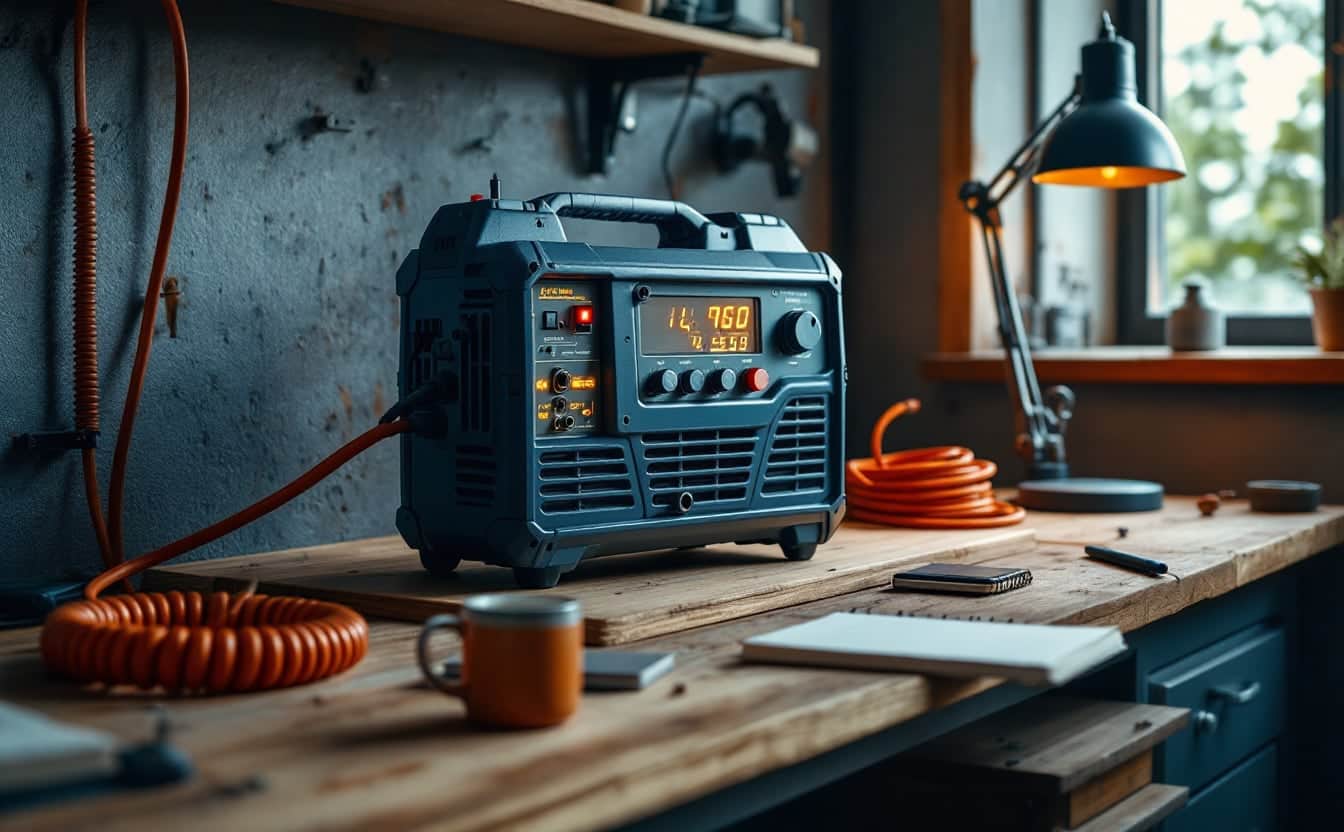
The best weather radio for an office or a home is a desktop NOAA Weather Radio receiver that sits on standby, sounds an alarm for warnings in your county and nowhere else, keeps working on batteries when the power fails, and lives where a person will hear it. That last point matters more than any feature. A radio in a locked supply closet protects nobody.
Ready list

Midland WR120B weather alert radio NOAA weather alerts
A desk or reception radio that sounds NOAA alerts for your county only (SAME coding).

FosPower hand-crank solar radio hand crank and solar
Hand crank, solar and battery power in one: radio, flashlight and a phone top-up when nothing else works.

Midland LXT600 two-way radios FRS, no license
License-free FRS radios with weather alert scan, for floor wardens and a site without phones.
Chosen from manufacturer specifications and published reviews, not tested by us. The full Readiness kit
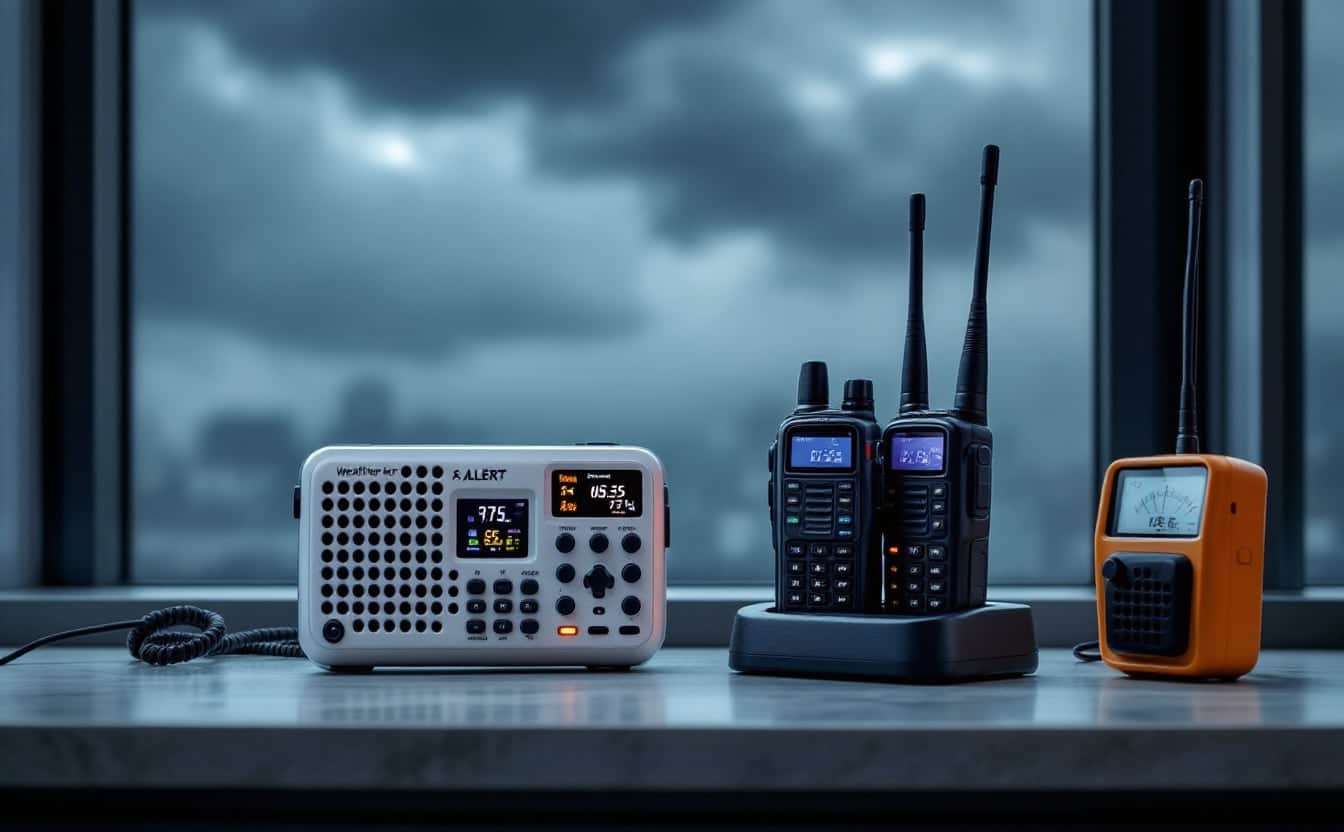
Two other radios round out the set. A hand-crank radio belongs in each go-bag, for news after the storm when nothing else has power. License-free two-way radios let floor wardens talk while the phones are busy. This guide covers what each needs to do, where to put them, and three picks.
What NOAA Weather Radio All Hazards is
NOAA Weather Radio All Hazards is the National Weather Service's own broadcast network. According to the NWS, it runs more than 1,000 transmitters across all 50 states, Puerto Rico, the U.S. Virgin Islands and the Pacific territories, on seven VHF frequencies from 162.400 to 162.550 MHz. Each station broadcasts around the clock. Routine forecasts repeat every few minutes, and forecasters break in with warnings when a threat develops.
"All Hazards" means more than weather. Working with the FCC's Emergency Alert System, the network also carries alerts for events such as chemical releases, earthquakes and AMBER alerts. Those frequencies sit outside the AM and FM bands, so you need a receiver built to pick them up.
Coverage has limits. NOAA's own brochure puts reliable reception at about 40 miles from a transmitter, less in a city surrounded by large buildings or in a mountain valley. It also advises testing a receiver where it will be used before you buy, which is sound advice for a reception desk on the ninth floor of a steel and concrete tower.
The features that matter
Start with the alerting chain, because that is what wakes a sleeping household or interrupts a busy front desk.
SAME, short for Specific Area Message Encoding, lets you program the radio with six-digit county codes so it alarms only for warnings that cover those places. Without it, a radio on a transmitter that serves several counties goes off for storms that will never reach you, and people soon learn to unplug it. You can look up your code on the NWS website or by calling 1-888-NWR-SAME.
The tone alarm is what turns a radio into an alarm. The NWS sends a 1050 Hz tone before most warnings and many watches, and receivers equipped for it switch on even with the volume turned down. SAME radios add the county filter on top.
Selectable events let you silence alerts that do not apply, such as coastal flood statements at an inland office. Battery backup keeps the radio listening when storms knock out power, which is exactly when you need it. An external antenna jack helps where reception is weak.
The Public Alert logo is the shortcut. It marks receivers certified to a Consumer Technology Association standard written with the NWS, and certified radios carry most of the features above.
| Feature | What to look for | Why it matters |
|---|---|---|
| Reception | All seven NOAA weather channels | Your nearest transmitter may use any of them |
| SAME coding | Several county codes stored | Alarms for your area only, so nobody unplugs it |
| Alerting | Siren plus a visual indicator | Heard in a noisy lobby, seen in a quiet one |
| Power | Mains power with battery backup | Keeps working through the outage |
| Antenna | External antenna jack | Rescues weak reception inside large buildings |
| Certification | Public Alert logo | A quick check for the features above |
| Accessibility | Accessory jack for a strobe or bed shaker | For anyone who is deaf or hard of hearing |
Readiness kit
- Midland WR120B weather alert radioNOAA weather alertsShop on Amazon
- FosPower hand-crank solar radiohand crank and solarShop on Amazon
- Midland LXT600 two-way radiosFRS, no licenseShop on Amazon
As an Amazon Associate I earn from qualifying purchases. All picks
Where to put a weather radio in an office
Put it where someone is always on duty during the hours people are in the building, and where that person knows what to do when it sounds.
- Reception, if it is staffed from opening to close.
- The security or facilities desk, especially if it covers nights and weekends.
- The crisis room or emergency operations center, if you run one. Our briefing on inside an emergency operations center covers what else belongs on that desk.
Then write down what happens next. A tornado warning on the radio is only useful if someone has the authority to move people to shelter and a way to tell them. Both belong in your emergency action plan, and the second depends on a notification system that works under pressure; our guide on what to test in mass notification systems covers that half.
Program your own county first. If storms usually arrive from one direction, add the county upwind for a little more notice. Learn the day and time of your local NWS office's routine weekly test and check that the radio registers it; some models log the test quietly instead of sounding the siren. Replace the backup batteries on a fixed date each year rather than when the low-battery light finally gets noticed.
At home, the same logic applies. Put the radio in a hallway or bedroom where the siren wakes people, not in the kitchen two floors down. Staff who work from home need one as much as the office does, since their home is now part of your continuity plan.
Crank radios for go-bags
A hand-crank radio is a different tool. It runs on a hand crank, a small solar panel or batteries, and it is meant for the days after an event, when the grid is down and phones are dying. Many also carry a flashlight and a USB port to top up a phone. Ready.gov's basic disaster supplies list includes both a battery-powered or hand-crank radio and a NOAA Weather Radio with tone alert, and the distinction is deliberate.
Many crank radios tune the weather band without any standby alert, so they will not wake anyone; the spec sheet tells you which kind you have. Treat one as a listening radio for a go-bag, a car or a shelter area, and keep a desktop alert radio as the alarm. Check that the model you choose receives the NOAA band, crank it once a quarter, and keep a set of spare batteries in the same bag.
FRS two-way radios for floor wardens
When the fire alarm is sounding, a phone call is hard to hear, and in a regional event the cell network can jam. Family Radio Service handhelds work without any network. The FCC licenses FRS by rule, so neither individuals nor businesses need a license, and there are 22 shared channels. Channels 8 to 14 are limited to half a watt, and the FCC puts their usual range at under half a mile; channels 1 to 7 and 15 to 22 allow up to 2 watts and longer range.
Practical rules for an office:
- Pick a primary and a backup channel from the higher-power groups and print them on a card in each radio's pouch.
- Privacy codes filter what your radio plays; they do not make the conversation private. Keep names and medical details off the air.
- Test from the deepest stairwell to the assembly point before you rely on the radios. Concrete and steel cut range sharply.
- Keep them on chargers at the warden stations, and check them monthly.
Some FRS models also scan the NOAA weather channels and sound an alert, a useful backup if wardens are outdoors at the assembly point during a storm.
Our picks
For the reception or facilities desk, Midland's product page describes the WR120 desktop alert radio as Public Alert certified, with SAME coding, up to 25 programmable locations, a 90 dB siren and backup power from three AA batteries. For go-bags, a crank radio with solar charging and the NOAA bands. For wardens, a set of FRS radios with weather scan.
Readiness kit
| Category | Pick | Why it is on the list | Link |
|---|---|---|---|
| Weather alert radio | Midland WR120B weather alert radio | A desk or reception radio that sounds NOAA alerts for your county only (SAME coding). | Shop on Amazon |
| Crank radio and light | FosPower hand-crank solar radio | Hand crank, solar and battery power in one: radio, flashlight and a phone top-up when nothing else works. | Shop on Amazon |
| Two-way radios | Midland LXT600 two-way radios | License-free FRS radios with weather alert scan, for floor wardens and a site without phones. | Shop on Amazon |
How these were chosen: from manufacturer spec sheets and published reviews, with no hands-on use by us. Whatever you buy, test reception in the exact spot where the radio will live, as NOAA itself recommends, and return it if it cannot hold a clear signal there.
Hurricane country adds one more reason to own all three; our hurricane season readiness guide shows where they fit in the countdown before a storm.
Kit check
- Midland WR120B weather alert radio NOAA weather alertsShop on Amazon
- FosPower hand-crank solar radio hand crank and solarShop on Amazon
- Midland LXT600 two-way radios FRS, no licenseShop on Amazon
Frequently asked questions
What is the best weather radio for a home?
A desktop NOAA Weather Radio with SAME county coding, a loud alarm and battery backup, ideally carrying the Public Alert logo. Put it where the alarm will wake people at night, program your county code, and replace the backup batteries once a year. Add a crank radio to your emergency kit for listening after the event.
Do I need a weather radio if my phone gets emergency alerts?
It is a sensible second channel. Phone alerts depend on the cellular network, on the phone being charged and nearby, and on alert settings people change. A weather radio listens to a separate broadcast and runs on batteries, so it covers some of the moments when a phone does not.
What is a SAME code and how do I find mine?
It is a six-digit code that identifies a county or part of a county in NOAA Weather Radio alerts. You can find yours on the National Weather Service website or by calling 1-888-NWR-SAME, then enter it following the radio's manual.
Will a weather radio work inside a large office building?
Often, but not always. Steel, concrete and distance from the transmitter weaken the signal, and NOAA advises testing a receiver where it will be used. A spot near a window or a radio with an external antenna jack usually solves it.