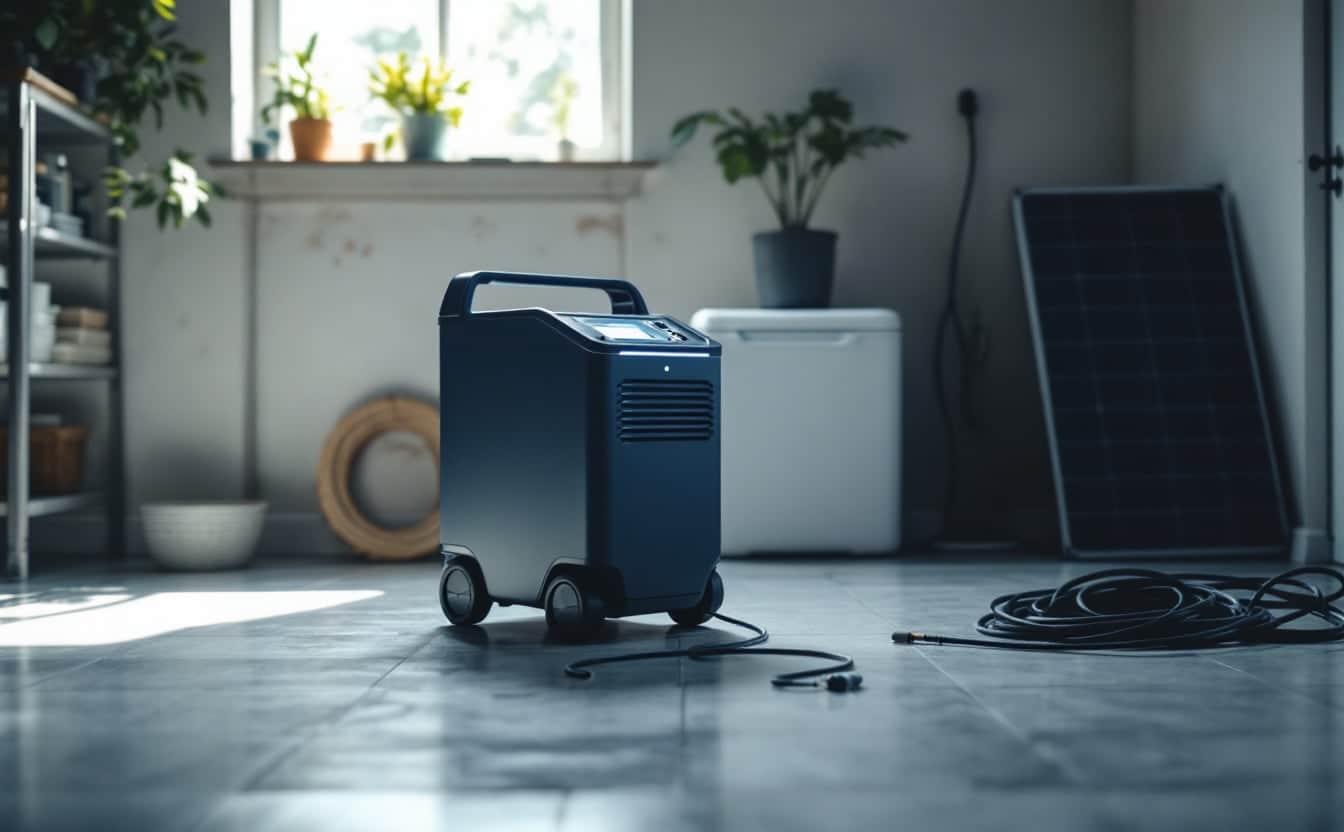
A 2000W portable power station, which in practice means about 2 kWh of battery behind 2,000 to 2,400 W of output, keeps a refrigerator and a chest freezer going for most of a day, or a home office through a day and a night. In an outage that runs for several days it lasts only as long as you can refill it, so plan solar panels or add-on batteries with it, not after. For a 240 V well pump, electric heat or a whole house for days, a generator or an installed system is the better tool.
Ready list
EcoFlow DELTA and RIVER stations Power station, expandable
Fast AC recharging, and the larger DELTA units take add-on batteries when a site needs more hours.
BLUETTI AC180 and AC series Power station, direct
LiFePO4 stations bought from the maker, with solar panel bundles and add-on batteries for longer outages.
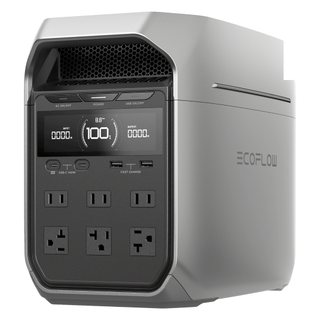
EcoFlow DELTA 3 Plus 1,024 Wh, under 10 ms UPS
A 1 kWh class station with a UPS mode EcoFlow rates at under 10 ms: the network and a laptop through a full outage day.
Chosen from manufacturer specifications and published reviews, not tested by us. The Readiness kit
What the 2 kW class gives you
The "2000W" label promises output, how much the station delivers at one moment. Capacity, in watt-hours, is how long it keeps doing it. In this class both sit around 2,000, enough output to start a fridge while the freezer and lights run, and enough capacity to carry them for much of a day. The main options, on their makers' figures:
| Station | Capacity | Continuous output | Peak or boost | Solar input | Expansion |
|---|---|---|---|---|---|
| Jackery Explorer 2000 v2 | 2,042 Wh | 2,200 W, 120 V | 4,400 W surge | Up to 400 W | None |
| BLUETTI AC200L | 2,048 Wh | 2,400 W | 3,600 W Power Lifting | Up to 1,200 W | To 8,192 Wh with two B300 |
| EcoFlow DELTA 2 Max | 2,048 Wh | 2,400 W | 3,400 W X-Boost | Up to 1,000 W | To 6,144 Wh with two extra batteries |
| EcoFlow DELTA Pro 3 | 4,096 Wh | 4,000 W, 120 V and 240 V | 6,000 W X-Boost | See the spec sheet | To 48 kWh |
All four use LiFePO4 cells. The Jackery weighs about 39.5 lb by its maker's figure; the expandable systems and their add-on batteries weigh more. Treat surge figures with caution: The Solar Lab measured peaks near 3,100 W on the Jackery Explorer 2000 v2, against 4,400 W on the box. Boost modes such as Power Lifting and X-Boost are meant for heating appliances like kettles, and do not help a motor start.
Start with the requirement: daily loads, burst loads and days
A long outage plan splits the house into three lists.
- Daily loads: the refrigerator, a freezer, the router and modem, lights, phones, perhaps a laptop.
- Burst loads, which run for minutes but draw heavily: a well pump, a microwave, a coffee maker.
- Loads to keep off the battery: space heaters, electric water heaters, ranges, central air.
Then decide the days: a storm night is one, a hurricane or an ice storm three or more. Our power station runtime calculator adds the daily loads, takes 85 percent of the rated capacity as usable, and gives the days a station covers and the capacity a plan needs.
For a freezer, use the yellow EnergyGuide label. A 7 cu ft chest freezer's label commonly shows about 250 kWh a year, roughly 690 Wh a day, which we entered as 29 W around the clock. A summer garage pushes it higher.
Readiness kit
- EcoFlow DELTA and RIVER stationsPower station, expandableGo to EcoFlow
- BLUETTI AC180 and AC seriesPower station, directGo to BLUETTI
- EcoFlow DELTA 3 Plus1,024 Wh, under 10 ms UPSGo to EcoFlow
What a 2 kWh station carries, by the calculator
The figures are the calculator's days covered at 85 percent efficiency: 1.0 means the station lasts the full daily pattern, 2.0 two days.
| Case | Energy per day | 2,042 Wh (Jackery) | 6,144 Wh (DELTA 2 Max, two extra batteries) | 8,192 Wh (AC200L, two B300) |
|---|---|---|---|---|
| Refrigerator alone, 150 W for 8 h | 1,200 Wh | 1.45 (about 35 h) | 4.35 | 5.80 |
| Fridge and chest freezer | 1,896 Wh | 0.92 (about 22 h) | 2.75 | 3.67 |
| Fridge, router and modem all day, two lamps | 1,848 Wh | 0.94 | 2.83 | 3.77 |
| Household core: fridge, freezer, internet, three lamps, two phones | 2,664 Wh | 0.65 (about 15.5 h) | 1.96 | 2.61 |
| Home office: laptop and monitor 8 h, internet all day, a lamp, a phone | 1,298 Wh | 1.34 | 4.02 | 5.36 |
The fridge line uses the calculator's preset, 150 W for 8 hours of compressor time a day; check yours against its label. A single 2 kWh station is a one-day answer for a household, and three days without recharging takes the expandable systems at their largest, or a lighter list.
You can stretch it by taking turns. FoodSafety.gov advises that with the doors closed, food stays safe for up to 48 hours in a full freezer and 24 hours in a half-full one, against up to 4 hours in a refrigerator. A full freezer kept shut can sit unpowered while the fridge runs, then take its turn. Put a thermometer in each.
Well pumps: check the voltage first
A well pump is often the reason people look at this class, and the load most likely to disappoint. Three checks come first.
The voltage. Many submersible pumps, particularly on deeper wells, run on 240 V and are wired to a pressure switch rather than plugged in. A station with only 120 V outlets, such as the Jackery Explorer 2000 v2, cannot run a 240 V pump; EcoFlow lists 120 V and 240 V output for the DELTA Pro 3. The pump's nameplate or your well contractor will tell you which you have.
The connection. Feeding a hard-wired pump, or any household circuit, takes a transfer switch or a power inlet installed by a licensed electrician. Back-feeding through an outlet endangers you and utility crews.
The start. Our generator size calculator puts a typical 1/2 hp well pump at 1,000 W running plus 2,100 W at start-up, about 3,100 W in all. That is above every continuous rating in the table except the DELTA Pro 3's, so the start depends on the real surge. Test it before you rely on it.
Energy is the easy part: every 15 minutes of pumping uses 250 Wh, so an hour a day takes 1,000 Wh, more than half of what a 2,042 Wh station delivers.
Space heaters: the hard limit
Heat is where battery arithmetic stops working. On a 2,042 Wh station, the calculator gives:
- A 1,500 W space heater on high: about 1 h 9 min.
- The same heater on a 750 W low setting: about 2 h 19 min.
- One hour of the heater on high plus the household core: 4,164 Wh for the day, so the station covers about 0.42 of it, roughly 10 hours.
A 2 kWh station warms one small room for an hour, then it is empty. Plan on layers, one closed-off room and heat that does not depend on the battery. A gas furnace needs electricity only for its hard-wired fans and controls, a job for a generator through a transfer switch. Never use a grill, a camp stove or a generator indoors to stay warm.
Multi-day outages: recharge or run out
Over three days, the calculator says the household core needs about 9,402 Wh of rated capacity, and the fridge with the internet and two lamps about 6,522 Wh: three to five 2 kWh stations. The realistic plan is one station plus a way to refill it every day.
Solar is the quiet option. As an illustration, take a site with the equivalent of four hours of full sun, and knock a quarter off the panels' rating for heat, angle, wiring and charging losses (NREL's PVWatts calculator uses a 14 percent default for system losses alone). On those assumptions:
- 400 W of panels, the Jackery 2000 v2's solar input limit, puts back about 1,200 Wh a day. The fridge, internet and two lamps draw about 2,174 Wh a day from the battery, so a full station plus that array lasts about two days rather than one.
- 1,000 W of panels, within the DELTA 2 Max's and AC200L's solar input, puts back about 3,000 Wh on such a day, more than that list uses.
The caveat is the weather: winter days are short and storms bring cloud, so solar often gives least when you need it most. Run PVWatts for your address and month.
Expansion or a second station
Expansion batteries share one inverter, one set of outlets and the same solar input. The Jackery Explorer 2000 v2 does not take them; the BLUETTI AC200L grows to 8,192 Wh, the EcoFlow DELTA 2 Max to 6,144 Wh, and the DELTA Pro 3 from 4 kWh to 48 kWh.
A second, smaller station is the other route. It can sit in another room, keep the internet up while the big unit carries the kitchen, and still work if the first one fails. A 1 kWh unit such as the BLUETTI AC180 fills that role; our guide to the 1000W class covers what that size runs.
When a generator is the better tool
A generator wins when the loads are big or the outage is long. Given a fridge, a chest freezer, a 1/2 hp well pump, ten LED bulbs and the modem and router, the generator size calculator gives 2,325 W running, a 4,525 W peak when the fridge starts, and about 2,906 W of recommended running output. Generator charts use cautious running figures to size the moment, so they read higher than the station calculator's daily averages, but that list is still beyond any 2 kWh station's continuous output.
A generator also refuels in minutes. The rules are not optional: Ready.gov says to run generators outdoors only, at least 20 feet from windows, doors and attached garages, with working carbon monoxide alarms on every level of the home, and a transfer switch fitted by a licensed electrician for household wiring. The two work well together: the station carries the night silently, and the generator runs for a few daylight hours to recharge it and run the pump.
Our picks for a long outage
The Jackery Explorer 2000 v2 is the simple choice: 2,042 Wh and 2,200 W in one box, no expansion, a 400 W solar limit. It suits a fridge and freezer, or a home office, for a day. For a plan that must grow, EcoFlow's DELTA range, up to the 240 V DELTA Pro 3, adds batteries. BLUETTI's AC series, bought direct, includes the AC200L with 1,200 W of solar input and expansion to 8,192 Wh. A BLUETTI AC180 makes a good second unit.
How we chose: these come from manufacturer specification sheets, product pages and published reviews. We did not test them ourselves, so check capacity, output, surge, voltage and solar input on the current product page.
Readiness kit
| Category | Pick | Why it is on the list | Link |
|---|---|---|---|
| Power station, expandable | EcoFlow DELTA and RIVER stations | Fast AC recharging, and the larger DELTA units take add-on batteries when a site needs more hours. | Go to EcoFlow |
| Power station, direct | BLUETTI AC180 and AC series | LiFePO4 stations bought from the maker, with solar panel bundles and add-on batteries for longer outages. | Go to BLUETTI |
Long-outage checklist
- Split the house into daily loads, burst loads and loads to keep off the battery.
- Read the freezer's and fridge's EnergyGuide labels for daily energy.
- Check the well pump's voltage, and have an electrician fit a transfer switch or inlet before the storm.
- Test the fridge and the pump on the station, under load.
- Work out the solar input you need for your month in PVWatts.
- Keep a heat plan that does not use the battery, and carbon monoxide alarms on every level.
For the rest of the household list, from water to lighting, see our emergency kit for home.
Sources
- Jackery Explorer 2000 v2 product page; The Solar Lab review of the Explorer 2000 v2.
- BLUETTI AC200L product pages.
- EcoFlow US product pages for the DELTA 2 Max and DELTA Pro 3.
- ENERGY STAR product finder and FTC EnergyGuide labels for chest freezers.
- NREL PVWatts Calculator
- FoodSafety.gov: Avoid Foodborne Illness During Temporary Power Outages
- Ready.gov: Power Outages
Kit check
- EcoFlow DELTA and RIVER stations Power station, expandableGo to EcoFlow
- BLUETTI AC180 and AC series Power station, directGo to BLUETTI
- EcoFlow DELTA 3 Plus 1,024 Wh, under 10 ms UPSGo to EcoFlow
Frequently asked questions
What will a 2000W portable power station run?
A refrigerator for about 35 hours on the calculator's fridge preset, a fridge and chest freezer for about 22 hours, or a home office day and night with some left over. It is not a heater: a 1,500 W space heater empties a 2,042 Wh station in about an hour.
Can a 2000W power station run a well pump?
Sometimes. The pump must run on 120 V if the station only has 120 V outlets, it must be connected through a transfer switch or inlet fitted by an electrician, and its start-up draw, about 3,100 W for a typical 1/2 hp pump, must fall within the station's real surge. Test it before an outage.
How many days will a 2000W power station last?
Without recharging, about 22 hours for a fridge and a chest freezer, and about 15 hours if the internet, lamps and phones run too. With expansion to 6 to 8 kWh, the fridge and freezer run for about 2.8 to 3.7 days. With enough solar input on clear days it can keep going; in cloudy weather, plan on less.
Is a 2000W power station or a generator better for a long outage?
A station is better indoors, at night and for electronics, with no fuel or fumes. A generator is better for well pumps, heating fans and several days of heavy loads, because it refuels in minutes. Many households use both: the station overnight, the generator in daylight to recharge it.